![Can SpaceX Run AI From Space? [Future Tech]](https://giglegravity.site/wp-content/uploads/2026/07/Can-SpaceX-Run-AI-From-Space-Future-Tech.jpg)
Space-Based AI Infrastructure: A New Frontier
The idea of running AI data centers in space is no longer just science fiction. It is getting closer to reality, but building and operating these systems in orbit may be even more difficult than launching them.
SpaceX has created major excitement because investors see it as more than a rocket company. They see the possibility of a business that could become the transport network, power provider, and cloud-computing platform for the future space economy.
One of the boldest ideas linked to this vision is the development of orbital data centers. These facilities could process huge amounts of AI workloads, support satellite networks, and reduce pressure on Earth-based data infrastructure. SpaceX is one of the most recognized companies exploring this area, but it is not the only player interested in building space-based computing systems.
The opportunity is massive, but the challenges are serious. Any company trying to operate data centers in low Earth orbit must deal with radiation, extreme temperatures, limited maintenance, power supply issues, cooling problems, and the high cost of space logistics. Launching hardware into space is difficult, but keeping it running reliably may be the bigger test.
Why Companies Want Data Centers in Orbit
The idea is easy to understand: place AI data centers in space, where solar energy is widely available and companies do not need to depend on land, water, or crowded power grids on Earth.
As artificial intelligence increases the need for massive computing power, some companies believe orbital data centers could reduce the pressure on Earth’s digital infrastructure. These systems may also help avoid public opposition, since many communities do not want large data centers built near their homes.
However, sending a satellite into space is very different from running a full industrial-scale computing system in orbit. Space creates serious technical problems. Radiation can damage sensitive electronics. Powerful computers produce large amounts of heat, and cooling them in space is much harder than cooling them on Earth. Maintenance is also difficult because repairs in orbit are extremely expensive. In addition, every kilogram of hardware launched into space adds major launch costs.
Experts in data center design and space systems engineering argue that building a reliable space-based data center will require solving challenges from both fields. It is not only a space project. It is also a major computing infrastructure, thermal management, energy systems, and engineering reliability challenge.
What Earth-Based Data Centers Need to Work
Modern data centers support many services people use every day, including cloud computing, video streaming, online banking, scientific research, and artificial intelligence. They may look like buildings filled with servers, but they are actually complex digital infrastructure systems that need stable power, cooling, networking, and maintenance to operate safely.
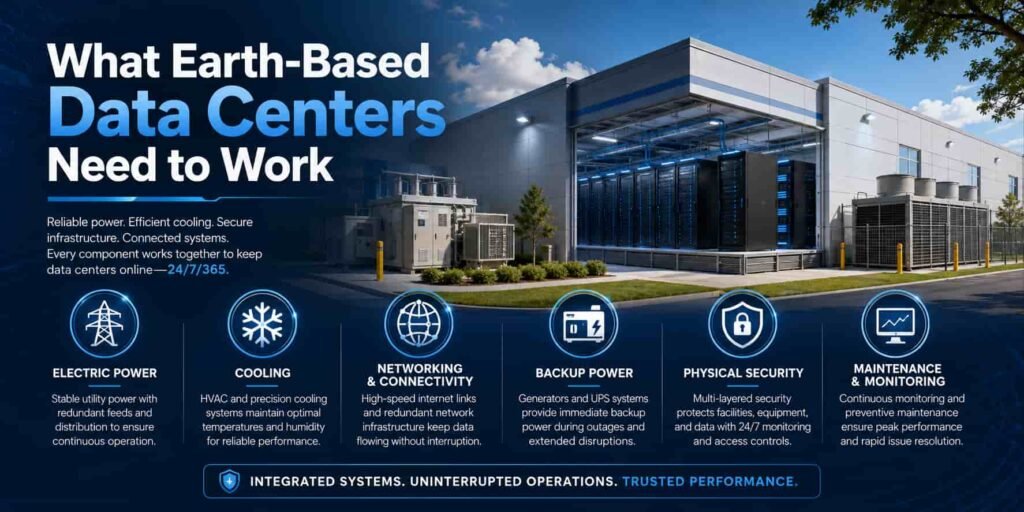
The first major requirement is electric power. Servers, networking equipment, and data storage systems use large amounts of electricity. As AI applications grow, the demand for computing power is increasing quickly, which also increases the amount of energy these facilities need.
The second major requirement is cooling. Most of the electricity used by servers turns into heat. If this heat is not removed quickly, the equipment can slow down, fail, or even force the entire data center to shut down.
To prevent this, data centers use advanced cooling systems such as air handling units, chillers, cooling towers, pumps, and liquid-cooling technology. In many facilities, cooling is the second-largest use of energy after the computing equipment itself.
The Physical Foundation of Data Centers
A data center also depends on strong physical infrastructure. This includes suitable land, secure buildings, strong structural support, reliable backup power, proper water systems, high-speed communication networks, and easy maintenance access.
Location is also important. A data center should be close enough to users, internet exchange points, and major network backbones so it can deliver fast and reliable digital services with low delay.
In simple terms, an Earth-based data center is not just a place filled with computers. It is a large electrical, thermal, and network infrastructure system designed to support powerful computing hardware.
Building Data Centers Beyond Earth
Building data centers in space sounds attractive because it could solve some major problems faced by Earth-based data centers. Companies are interested in this idea because space offers access to strong solar energy, avoids limits related to land, water, and local power grids, and may reduce public opposition to large infrastructure projects.
Like data centers on Earth, space-based data centers would need huge amounts of electric power. In orbit, this power would mainly come from solar panels. Sunlight is more reliable in space because there are no clouds, storms, or weather conditions blocking it. However, solar panels can still lose power when the Earth’s shadow blocks sunlight during part of the orbit. Even the most advanced solar cells cannot convert all sunlight into electricity, so power generation would still have limits.
Cooling is another major challenge. Space is extremely cold, with a background temperature close to minus 270 degrees Celsius. At first, this seems useful because the waste heat from powerful computing hardware could be released into space through thermal radiators. This could reduce the need for large cooling towers, chillers, and water-based cooling systems used on Earth.
However, cooling in space is not simple. There is no air in space to carry heat away from hot equipment. Instead, heat must leave through infrared radiation, which is much slower. Because of this, removing large amounts of waste heat may require enormous radiator surfaces. For example, cooling a 10-megawatt data center could need radiator panels as large as two football fields, in addition to the large area already needed for solar panels.
One possible benefit of orbital data centers is that they could avoid some local conflicts on Earth. Many communities oppose new data center construction because these facilities use large amounts of land, energy, and water, while also creating noise, environmental concerns, and pressure on local infrastructure.
In simple terms, putting AI data centers in orbit could reduce some problems on Earth, but it would create new engineering challenges in power generation, thermal management, space infrastructure, radiation protection, and long-term system reliability.
Read Also: Exploding Stars May Expose Dark Energy [Cosmic Clue]New Challenges of Orbital Data Centers
A space-based data center could reduce pressure on local communities because it would not compete for land, water resources, or nearby power infrastructure in the same way as a ground-based facility. It would also avoid common local concerns such as neighborhood noise, zoning approval, and land-use disputes.
However, orbit is already becoming crowded. Launching thousands of large orbital data centers could make this problem worse. Space debris and micrometeorites are serious risks because even small objects moving at high speed can damage or puncture a space-based facility. In the worst case, a major collision could destroy the system and create even more orbital debris, increasing danger for other satellites and spacecraft.
The large number of rocket launches needed to carry equipment into orbit could also raise concerns on Earth. Some communities near launch sites may object to frequent launches because of possible environmental impact, noise, and disruption. For example, SpaceX has faced criticism and protests near its Boca Chica, Texas launch site, where local activists have argued that rocket testing and launches affect the surrounding environment.
Another major challenge is data transmission. Huge amounts of information would need to move between Earth-based networks, space-based data centers, and other orbital systems. This would require advanced radio communication or laser communication systems. Satellite networks such as Starlink and Amazon Leo show that space-based connectivity is possible, but the amount of data needed for large-scale AI computing, cloud services, and orbital infrastructure would be far greater than today’s satellite internet traffic.
In simple terms, data centers in space may reduce some problems on Earth, but they would create new risks related to space congestion, orbital debris, launch activity, environmental concerns, and high-volume data communication.
Operational Barriers in Orbital Data Centers
One major challenge is that space-based data centers, together with their solar panels, radiators, and support systems, cannot be launched as one complete structure. They would need to be transported in separate parts and then built in orbit. This would require advanced in-space assembly, servicing technologies, robotic maintenance, and space manufacturing systems.
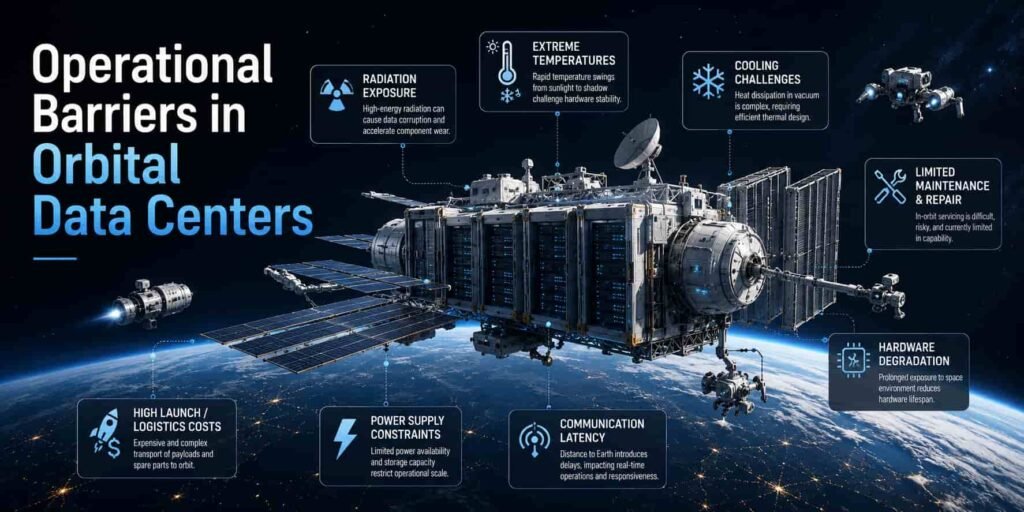
Another important issue is the hardware refresh cycle. On Earth, data center servers are usually upgraded or replaced every three to five years because chips improve, computing workloads change, and equipment becomes old. This process is simple on the ground because technicians can directly remove, repair, or replace faulty parts.
In space, however, server upgrades, component replacement, and hardware repair become much more difficult and expensive. Once computing equipment is placed in orbit, updating it may not be practical. If too many systems fail, or if the platform cannot keep up with new AI workloads, machine learning models, data processing needs, and high-performance computing requirements, the entire facility could become outdated long before its physical structure reaches the end of its service life.
Economic and Environmental Risks in Space Computing
In the computing industry, performance improves very quickly, and demand for AI processing, data storage, and high-performance computing continues to grow. Because of this, keeping space-based data centers updated could become a serious economic challenge and operational burden.
Another major issue is the extreme space environment. These facilities would operate in a near vacuum and face constant exposure to space radiation, which can damage sensitive computer hardware, servers, and electronic components. Depending on their orbit, they may also move repeatedly between intense heat in direct sunlight and extreme cold in Earth’s shadow. This rapid temperature change could place heavy stress on cooling systems, radiators, power systems, and overall data center infrastructure.
Together, these factors show that building reliable orbital data centers is not only a technical problem but also a long-term challenge involving maintenance, energy management, hardware durability, thermal control, and system reliability.
Practical Value of Space-Based Data Centers
Even with serious technical and economic barriers, some companies are still exploring space-based data centers. SpaceX has introduced the concept of its AI1 Compute Satellite, which is planned as an orbital data center spacecraft. However, its current design is still far less powerful than modern Earth-based data centers, making it unsuitable for many large-scale cloud computing tasks.
The main issue is that not every computing workload should be handled in space. Many services need very fast response times and strong links with users on Earth. For example, financial transactions, interactive AI tools, real-time cloud services, and most online applications are highly sensitive to latency, which means even a small delay can reduce performance.
More realistic early uses may involve tasks that do not require instant response. These could include satellite data processing, Earth observation analysis, military data processing, intelligence operations, scientific computing, space mission support, and specialized AI processing for satellites or other space assets.
In simple terms, the first successful orbital data centers will likely support customers and systems already operating in space. They are unlikely to replace normal terrestrial data centers or mainstream cloud infrastructure in the near future.
Summary: Can SpaceX Run AI From Space? [Future Tech]
Space-based AI data centers could support future AI computing, satellite networks, and space operations, but they are extremely difficult to build and maintain.They would need reliable solar power, advanced cooling systems, strong radiation protection, and large orbital infrastructure.Major challenges include space debris, high launch costs, hardware repair, server upgrades, and fast-changing computing demands.These systems may first be useful for satellite data processing, Earth observation, military tasks, and space mission support.For now, they are unlikely to replace normal Earth-based data centers or mainstream cloud computing services.