![AI Ignites the Superconductor Race [Game-Changer]](https://giglegravity.site/wp-content/uploads/2026/07/AI-Ignites-the-Superconductor-Race-Game-Changer.jpg)
Artificial Intelligence Speeds Up the Search for Superconductors
YRu₃B₂ and LuRu₃B₂ become superconducting because their electrons form flat bands within a kagome lattice. This structure is named after a traditional Japanese basket-weaving design made of repeating hexagonal patterns.
Machine learning is helping researchers discover new superconducting materials more quickly. An international research team has shown that artificial intelligence can examine a huge number of possible material combinations and identify the candidates most likely to become successful superconductors.
Professor Päivi Törmä of Aalto University, who leads the SuperC consortium, believes this method could greatly accelerate materials discovery and reduce the time needed for laboratory testing.
Superconductors carry electric current with zero electrical resistance, meaning almost no energy is lost during transmission. However, most superconductors work only at extremely low temperatures, where unusual quantum effects become important.
These materials already support several advanced technologies, including quantum computers, medical neuroimaging, fusion reactors, and magnetic-levitation trains. By combining AI-driven screening, quantum physics, and materials science, researchers may discover more practical superconductors for future energy, transport, computing, and healthcare systems.
The Search for a Room-Temperature Superconductor
Finding new superconductors is extremely difficult because scientists must examine an almost unlimited number of chemical element combinations. Only a very small number of these combinations develop superconducting properties.
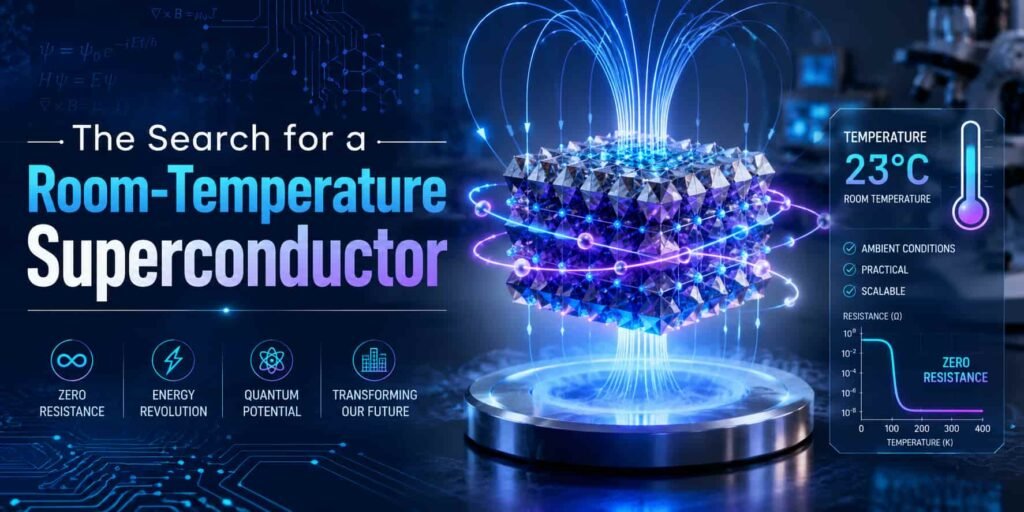
Most superconductors discovered so far work only when cooled to temperatures close to absolute zero. Reaching such conditions requires expensive cryogenic cooling systems, which limits their practical use.
Researchers worldwide are therefore trying to develop a room-temperature superconductor that can carry electricity with zero electrical resistance under normal conditions.
Professor Päivi Törmä explains that such a breakthrough could transform global energy consumption. Replacing ordinary electrical conductors in computers, data centers, and other digital systems could greatly reduce power loss, lower operating costs, and decrease the heat footprint of the information and communications technology sector.
A practical room-temperature superconductor could lead to cleaner, more efficient, and more sustainable energy systems.
Machine Learning Accelerates Superconductor Discovery
The SuperC consortium was founded in 2023 by Professor Päivi Törmä and a global team of leading physicists. Its mission is to use quantum physics to support solutions for climate change. The consortium is the first organized international research effort focused entirely on discovering new superconductors, with the goal of finding a room-temperature superconductor by 2033.
The researchers combine quantum geometry with machine learning to search for promising materials. Their latest discoveries, YRu₃B₂ and LuRu₃B₂, become superconducting because their electrons form flat bands inside a kagome lattice. This geometric structure is based on a traditional Japanese basket-weaving pattern.
To find these compounds, the team used an advanced AI algorithm to screen a vast number of possible elemental combinations. The system quickly selected the strongest candidates. Scientists then used detailed quantum calculations to predict whether these materials could show superconducting properties.
After the theoretical results appeared promising, researchers at Rice University created the materials by combining their chemical elements into new compounds. Led by Professor Emilia Morosan, the team tested both materials in the laboratory and confirmed that they are genuine superconductors.
This research shows how artificial intelligence, quantum mechanics, materials science, and experimental physics can work together to speed up the discovery of advanced energy materials.
AI Could Transform the Search for Better Superconductors
A new proof-of-concept study, published in Physical Review Research, shows how artificial intelligence could make the discovery of new superconducting materials much faster and more efficient.
Reducing the Cost of Superconductor Discovery
Scientists still find it extremely difficult to develop a complete quantum mechanical explanation of superconductivity. As a result, searching for materials that can conduct electricity without resistance requires extensive calculations, powerful computers, and considerable time.

According to researcher Päivi Törmä, scientists have identified more than 7,000 superconductors, but chance discoveries played a major role in finding most of them. Researchers have theoretically predicted the potential of only around 20 materials because traditional computational screening methods require enormous computing power.
A material may also appear suitable during theoretical testing but fail in practice. Some promising compounds are difficult to synthesize, while others cannot support reliable large-scale production.
Machine Learning Speeds Up Material Screening
The SuperC research team has developed an AI-driven material discovery method that could overcome these challenges. The system first uses machine-learning-based pre-screening to examine a large number of possible materials. It then performs detailed quantum calculations only on the candidates that show the greatest potential.
This targeted process reduces unnecessary calculations and allows researchers to focus their resources on the most promising compounds. Törmä believes that machine learning algorithms could eventually help scientists analyse billions of materials instead of testing only a limited number.
By combining artificial intelligence, materials science, and computational physics, the approach could greatly accelerate superconductor discovery. It may also bring researchers closer to identifying a practical room-temperature superconductor, which could transform energy systems, electronics, medical technology, and transportation.
Future Exhibition and Research Support
The SuperC project will appear at Aalto University’s Designs for a Cooler Planet exhibition in Greater Helsinki, Finland, from 1 September to 30 October 2026.
The SuperC consortium receives financial support from The Kavli Foundation, Klaus Tschira Stiftung, Kevin Wells, the Jane and Aatos Erkko Foundation, the Keele Foundation, the Magnus Ehrnrooth Foundation, and the Neste and Fortum Foundation.
Read Also: Your WiFi May Recognize Who You Are [Shocking]Summary: AI Ignites the Superconductor Race [Game-Changer]
Artificial intelligence is helping scientists identify promising superconducting materials much faster than traditional methods. The SuperC team used machine learning and quantum calculations to discover YRu₃B₂ and LuRu₃B₂, which were later confirmed as superconductors. These materials contain flat electronic bands within a kagome lattice structure.The new approach could allow researchers to screen billions of material combinations while reducing cost and computing time. This research may bring science closer to developing a practical room-temperature superconductor.