![North Sea Asteroid Hit That Sparked a Mega Tsunami [Shock]](https://giglegravity.site/wp-content/uploads/2026/07/North-Sea-Asteroid-Hit-That-Sparked-a-Mega-Tsunami-Shock.jpg)
Ancient Impact Beneath the North Sea Confirmed
Researchers have now confirmed that the Silverpit Crater, hidden beneath the North Sea, was formed by a powerful asteroid or comet impact around 43 to 46 million years ago. The collision struck the region with extreme force and may have triggered a massive tsunami across the ancient sea.
The discovery ends a scientific debate that continued for more than 20 years. For a long time, experts disagreed about whether the crater was caused by a space rock, natural underground movement, or another geological process. New evidence now supports the view that Silverpit is a real impact crater.
This makes the Silverpit Crater one of Earth’s rare confirmed geological scars left behind by a high-speed cosmic collision. The finding also helps scientists better understand how ancient asteroid impacts shaped Earth’s surface and affected prehistoric environments.
Strong Evidence Supports a Space Impact
A research team led by Dr. Uisdean Nicholson from Heriot-Watt University in Edinburgh has presented strong evidence that the Silverpit Crater was created by an extraterrestrial impact. The study was funded by the Natural Environment Research Council (NERC).
To reach this conclusion, the researchers used advanced seismic imaging, microscopic rock analysis, and computer simulations. These methods helped them examine the crater’s structure, study the affected rocks, and model how an asteroid or comet collision may have formed the crater.
Their findings were published in Nature Communications, adding major scientific support to the impact theory.
Silverpit Crater: A Buried Mystery in the North Sea
The Silverpit Crater is located about 700 meters beneath the seabed of the southern North Sea, nearly 80 miles from the Yorkshire coast. Since it was discovered in 2002, the hidden structure has raised many questions among geologists.
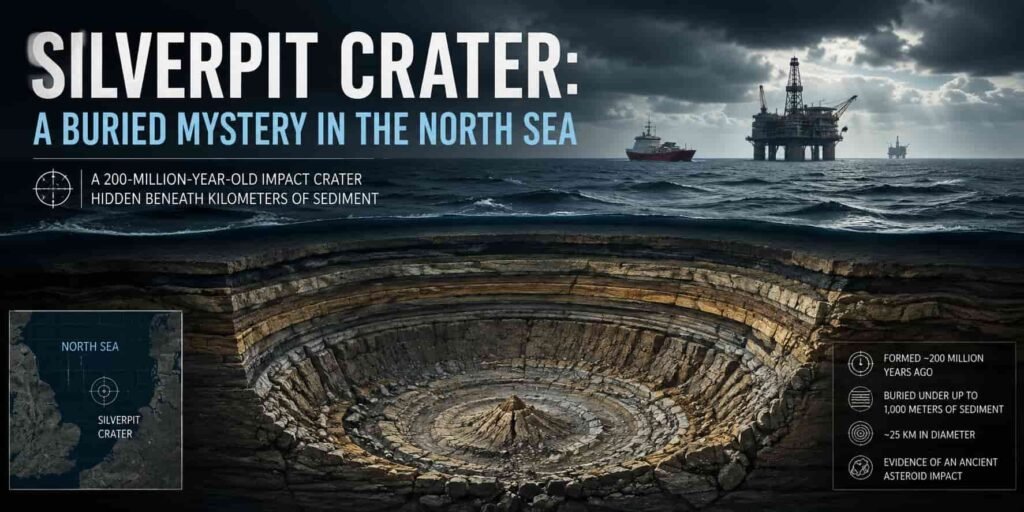
The main crater is about three kilometers wide and is surrounded by a much larger system of circular faults stretching nearly 20 kilometers. These faults are cracks in rock layers that form when the Earth’s crust is placed under pressure or shifts over time.
For years, many scientists argued that Silverpit was formed by a hypervelocity impact, meaning a high-speed collision caused by an asteroid or comet moving several miles per second. Its round shape, central peak, and unusual fault pattern looked similar to features found at other confirmed impact craters around the world.
However, this explanation was strongly debated. Some researchers believed the crater formed because of movement in underground salt deposits, while others suggested it may have been linked to volcanic activity and seabed collapse.
The debate became so serious that geologists voted on Silverpit’s origin in 2009. At that time, most rejected the impact theory. However, the latest scientific evidence now challenges that earlier view and strongly supports the idea that Silverpit was created by a powerful space rock impact.
New Seismic Data Points to an Ancient Impact
Scientists used new seismic data to study the Silverpit Crater again and better understand how it formed. Seismic imaging works like an ultrasound scan for the Earth. It uses reflected sound waves to create detailed images of buried rock layers beneath the seabed.
This method helped researchers examine the crater’s hidden structure more clearly and gather stronger evidence for an ancient asteroid impact in the North Sea.
Read Also: Tiny Soil Microbes May Save Salty Farms [New Hope]Shocked Minerals Confirm the Silverpit Impact
The new seismic images gave researchers the clearest view so far of the Silverpit Crater’s internal structure. The team also studied rock fragments taken from an oil exploration well near the crater site.
The samples contained rare shocked quartz and shocked feldspar crystals at the same depth as the crater floor. These minerals are important because their microscopic patterns can only form under extreme shock pressure.
According to Dr. Uisdean Nicholson, a sedimentologist at Heriot-Watt University’s School of Energy, Geoscience, Infrastructure and Society, finding these crystals was extremely rare and difficult. He explained that their structure provides strong proof for the impact crater hypothesis.
Shocked minerals are among the strongest signs of an asteroid or comet impact. Normal geological activity cannot create the enormous pressure needed to form these crystal structures. This evidence strongly supports the conclusion that the Silverpit Crater was created by a powerful extraterrestrial impact beneath the North Sea.
North Sea Asteroid Triggered a Giant Tsunami
Scientists estimate that the object that struck the North Sea was about 160 meters wide, or roughly 525 feet across. It likely came from the west and hit the seabed at a low angle.
Although this asteroid was much smaller than the one linked to the dinosaur extinction, it was still powerful enough to cause major destruction. The impact quickly formed the Silverpit Crater and forced huge amounts of rock, sediment, and seawater into the air.
According to Dr. Uisdean Nicholson, the collision created a massive curtain of rock and water about 1.5 kilometers high. When this material collapsed back into the sea, it generated a tsunami more than 100 meters high.
A wave of that size would have risen over 330 feet above sea level, making it taller than many modern buildings. This shows how even a relatively small space rock can cause extreme damage when it hits Earth at high speed.
Key Evidence Strengthens the Impact Theory
Professor Gareth Collins of Imperial College London also contributed to the new Silverpit Crater study. He had previously taken part in the 2009 debate about whether the crater was formed by an asteroid impact or by normal geological processes.
For this research, Collins created numerical models to simulate the ancient collision. These computer simulations helped scientists compare the expected effects of an extraterrestrial impact with the crater’s real underground structure.
Collins explained that he had always considered the impact hypothesis to be the simplest and most convincing explanation. With the new evidence, researchers now have the “silver bullet” they needed to confirm the crater’s origin.
The findings will also help scientists understand how asteroid impacts shape planetary surfaces and hidden subsurface structures, not only on Earth but also on other planets where direct study is much harder.
Why Ancient Impact Craters Often Disappear
Although many asteroids and comets have struck Earth over its long history, only a small number of impact craters can still be seen today. This is because Earth is an active planet, and its surface is always changing.
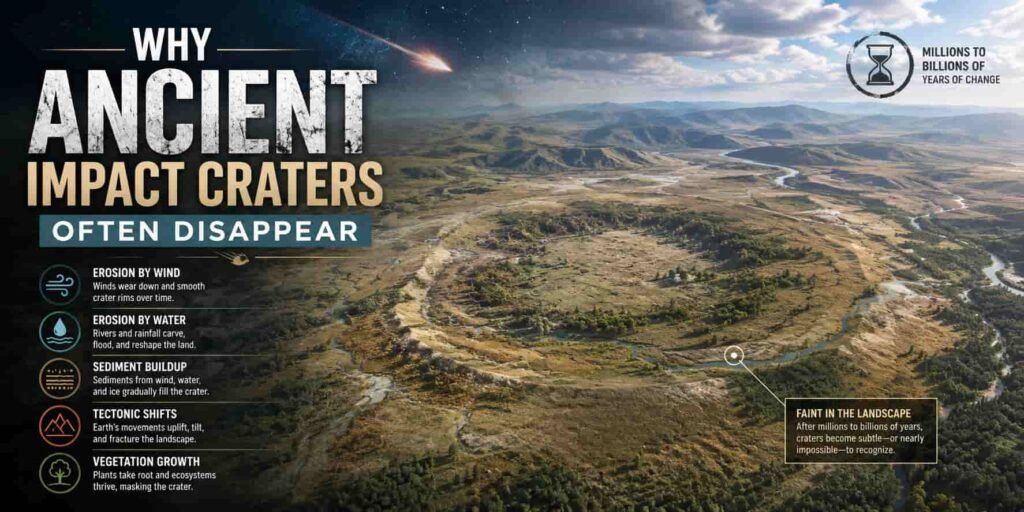
Natural processes such as erosion, weathering, volcanic activity, and plate tectonics slowly reshape the planet. Over millions of years, these forces can destroy or hide the evidence of ancient cosmic impacts.
According to Dr. Uisdean Nicholson, the Silverpit Crater is especially important because it is a rare and well-preserved hypervelocity impact crater. Around 200 confirmed impact craters have been found on land, while only about 33 underwater impact craters have been identified beneath the oceans.
Studying Silverpit can help scientists understand how asteroid impacts changed Earth in the past. It can also improve predictions about what might happen if a future asteroid collision were to strike our planet.
Silverpit Joins Earth’s Confirmed Impact Sites
The confirmation of the Silverpit Crater places it among a small group of recognized impact structures on Earth. These sites are formed when an asteroid or comet strikes the planet at very high speed.
Silverpit now stands alongside famous examples such as Mexico’s Chicxulub Crater, which is strongly linked to the mass extinction that killed the non-avian dinosaurs about 66 million years ago.
It can also be compared with the Nadir Crater near the coast of West Africa, another underwater impact crater that was confirmed more recently. Together, these discoveries help scientists understand how powerful cosmic collisions have shaped Earth’s history.
Silverpit Offers New Insight Into Planetary Impacts
Scientists can now study the Silverpit Crater as a valuable natural laboratory for understanding how asteroid impacts shape Earth and other worlds in the solar system. Since the crater’s origin has now been confirmed, researchers can use it to learn more about impact craters, cosmic collisions, seafloor geology, and hidden planetary structures beneath the surface.
This research was funded by the Natural Environment Research Council (NERC).
Read Also: Hawaii Builds Roads From Fishing Nets [Ocean Rescue]Summary: North Sea Asteroid Hit That Sparked a Mega Tsunami [Shock]
The Silverpit Crater beneath the North Sea has been confirmed as an ancient asteroid or comet impact crater formed around 43 to 46 million years ago.New seismic imaging, rock sample analysis, and computer simulations revealed strong evidence, including rare shocked quartz and feldspar crystals.Scientists estimate the impact object was about 160 meters wide and may have triggered a tsunami over 100 meters high.This discovery ends a debate lasting more than 20 years and places Silverpit among Earth’s rare confirmed impact structures.The crater now offers scientists a valuable way to study how cosmic collisions shape Earth and other planets.