![Millions May Be Getting the Wrong Cholesterol Test [Warning]](https://giglegravity.site/wp-content/uploads/2026/07/Millions-May-Be-Getting-the-Wrong-Cholesterol-Test-Warning.jpg)
A Better Way to Measure Heart Disease Risk
A newer blood test may help doctors identify heart disease risk more accurately than the standard LDL cholesterol test, according to new research from Northwestern Medicine.
Every year, millions of Americans check their LDL cholesterol, often called bad cholesterol, to understand their risk of heart attacks and strokes. However, a study published in JAMA suggests that measuring apolipoprotein B, also known as apoB, may give a clearer picture of who needs stronger cholesterol-lowering treatment.
The research found that apoB testing may be more useful than LDL cholesterol or non-HDL cholesterol when doctors decide whether a patient should receive more aggressive treatment, such as statins or other cholesterol-lowering medications.
In simple terms, apoB helps measure the number of harmful cholesterol-carrying particles in the blood. These particles can build up inside the arteries and increase the risk of cardiovascular disease, blocked arteries, heart attack, and stroke.
This means that relying only on LDL levels may not always give the full picture. For some patients, an apoB test could help doctors make better decisions about preventive heart care, risk assessment, and personalized treatment.
ApoB Testing May Offer Better Value in Heart Prevention
Using apoB testing to guide stronger cholesterol-lowering treatment may help prevent more heart attacks and strokes than the current standard approach, according to Ciaran Kohli-Lynch, the study’s lead author and assistant professor of preventive medicine and epidemiology at Northwestern University Feinberg School of Medicine.
Kohli-Lynch explained that the health benefits of apoB-guided treatment could be achieved at a cost that offers good value for U.S. healthcare payers. He also noted that this is the first detailed analysis to show that using apolipoprotein B, or apoB, to guide cholesterol treatment decisions may also be cost-effective.
Heart disease is still the leading cause of death in the United States and creates a major financial burden for the healthcare system. Over time, small cholesterol-carrying particles can enter and stay inside the artery walls. These particles may slowly form plaque buildup, narrow the arteries, reduce blood flow, and increase the risk of cardiovascular disease, heart attack, and stroke.
In simple terms, apoB testing may help doctors find high-risk patients earlier and choose better preventive heart care, especially when deciding whether to increase statins or other cholesterol-lowering medications.
Why ApoB Testing May Give a Clearer Picture of Heart Risk
For many years, doctors have used LDL cholesterol and non-HDL cholesterol levels to decide when a person should start or increase cholesterol-lowering treatment. These tests are helpful, but they may not show the full level of a person’s cardiovascular risk.
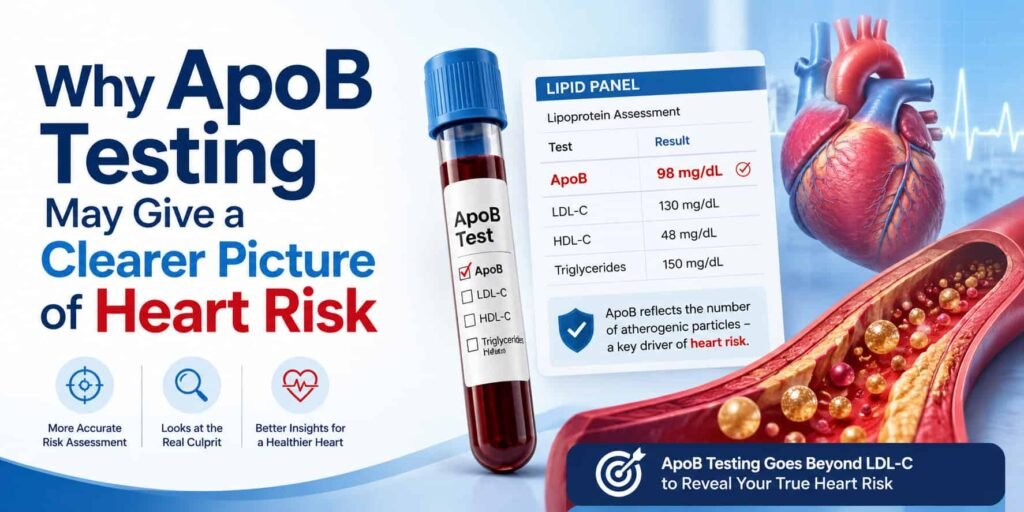
According to Ciaran Kohli-Lynch, research shows that apolipoprotein B, also called apoB, may be better at finding people who are at higher risk. This is because apoB testing counts the total number of harmful cholesterol-carrying particles in the blood.
Standard cholesterol tests mainly measure the amount of cholesterol. In comparison, apoB measures the number of particles that can enter the artery walls, cause plaque buildup, narrow the arteries, and increase the risk of heart disease, heart attack, and stroke. This may make apoB a more direct marker of heart disease risk.
Although more research supports the value of apoB testing, it is still not widely used in everyday medical care. One reason is that apoB measurement usually requires an extra blood test beyond the regular cholesterol panel. This can add more cost, time, and inconvenience for patients and healthcare systems.
The main question of the study was simple: does the extra cost of using apoB instead of LDL cholesterol provide enough benefit when guiding stronger cholesterol treatment?
How Researchers Tested Different Cholesterol Treatment Methods
To find out whether apoB testing is worth the extra cost, researchers built a computer simulation based on 250,000 U.S. adults. These adults were eligible for statin therapy, but they did not already have cardiovascular disease.
The model compared three ways doctors could guide cholesterol-lowering treatment:
LDL cholesterol with a target below 100 mg/dL
Non-HDL cholesterol with a target below 118 mg/dL
Apolipoprotein B, or apoB, with a target below 78.7 mg/dL
When patients did not reach their target level, doctors would increase treatment. First, they used stronger statins. If that was not enough, they added ezetimibe, another cholesterol-lowering medication.
The researchers studied each method over a person’s lifetime. They estimated the number of heart attacks, strokes, cardiovascular events, changes in life expectancy, quality of life, and total healthcare costs.
The results showed that using apoB to guide treatment performed better than both LDL cholesterol and non-HDL cholesterol. The apoB-based strategy improved overall health outcomes, helped prevent more heart attacks and strokes, and was considered cost-effective for long-term heart disease prevention.
Read Also: Hidden Brain Activity Seen Under Anesthesia [Discovery]Why Accurate Cholesterol Testing Matters More Now
Accurate cholesterol testing is becoming more important as doctors now have more cholesterol-lowering medications available than in the past.
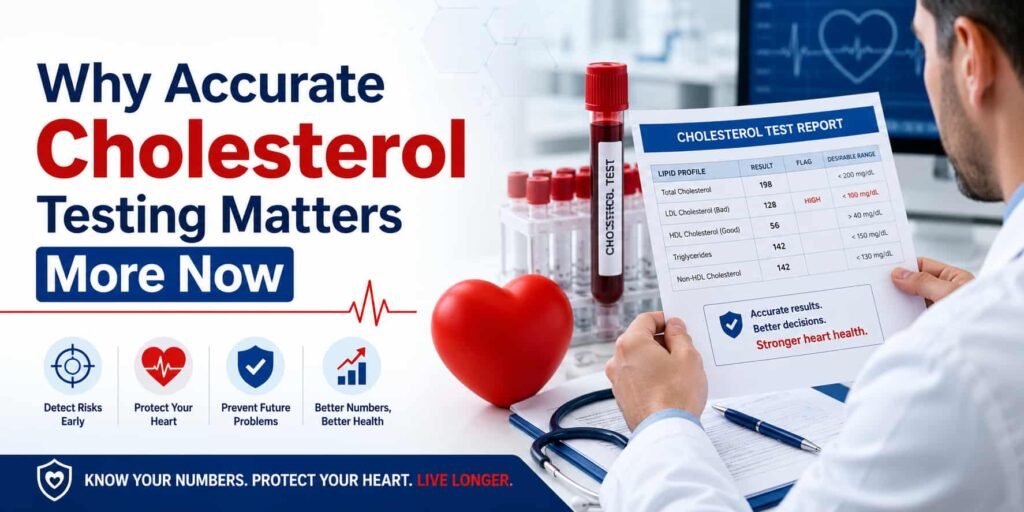
Earlier this year, the American Heart Association and 10 other medical organizations released updated cholesterol treatment guidelines. These new recommendations suggest that many people may need to begin cholesterol-lowering therapy at younger ages to reduce the risk of heart disease, heart attack, and stroke.
According to Ciaran Kohli-Lynch, this makes it even more important to identify which patients are most likely to benefit from stronger preventive treatment. Better testing can help doctors choose the right patients for intensive cholesterol management, instead of relying only on traditional LDL cholesterol or non-HDL cholesterol levels.
The Northwestern Medicine study was titled “Cost-Effectiveness of ApoB, Non-HDL-C, and LDL-C Goals for Primary Prevention Lipid-Lowering Therapy.” Other Northwestern coauthors included Dr. John Wikins and Dr. Samuel Luebbe.
The research was supported by the American Heart Association Career Development Award 24CDA1274989, awarded to Dr. Kohli-Lynch.
Summary
A new study suggests that apoB testing may measure heart disease risk more accurately than standard LDL cholesterol or non-HDL cholesterol tests.Researchers found that using apoB to guide cholesterol-lowering treatment could prevent more heart attacks and strokes.ApoB works by counting harmful cholesterol-carrying particles that can build up in arteries and cause plaque formation.The study also found that apoB-guided treatment may be cost-effective for long-term heart disease prevention.As new guidelines encourage earlier treatment, accurate testing may help doctors choose the right patients for stronger preventive care.