![Exploding Stars May Expose Dark Energy [Cosmic Clue]](https://giglegravity.site/wp-content/uploads/2026/07/Exploding-Stars-May-Expose-Dark-Energy-Cosmic-Clue.jpg)
New AI Method Could Improve Dark Energy Research
A team of astronomers has introduced a new AI-driven tool that may help scientists study the Universe more clearly and better understand dark energy, the mysterious force linked to the Universe’s expansion.
The research team, led by the Institute of Cosmos Sciences at the University of Barcelona (ICCUB), created a new framework called CIGaRS. This method is designed to collect more useful information from Type Ia supernovae, which are bright stellar explosions that scientists use to measure huge cosmic distances.
The study, published in Nature Astronomy, shows that CIGaRS can work mainly with imaging data instead of depending heavily on costly spectroscopic observations. This makes the technique more practical for studying large numbers of supernovae across the sky.
The new approach could become especially important as future next-generation sky surveys begin producing massive amounts of astronomical data. One major source of this data will be the Vera C. Rubin Observatory, which is expected to observe millions of objects in space.
By improving how scientists analyze Type Ia supernovae, this AI-based framework may help researchers make more accurate distance measurements, track the cosmic expansion rate, and investigate the true nature of dark energy.
Why These Stellar Explosions Are Important
Type Ia supernovae happen when white dwarf stars explode. These explosions are extremely useful in astronomy because they usually reach a very similar true brightness. For this reason, scientists call them standard candles.
By comparing a supernova’s intrinsic brightness with how bright it looks from Earth, astronomers can estimate how far away it is. This helps researchers measure huge cosmic distances and build a clearer picture of the Universe.
These distance measurements were central to one of the biggest discoveries in modern science: the Universe is expanding faster over time. Scientists believe this accelerated cosmic expansion is caused by dark energy, a mysterious force that remains one of the greatest unsolved problems in modern physics.
However, there is still a challenge. Type Ia supernovae are very similar, but they are not exactly the same. Small differences between these stellar explosions can affect how accurately scientists measure distance and study the expansion of the Universe.
Why a Supernova’s Galaxy Matters
Astronomers have learned that a Type Ia supernova’s observed brightness can be affected by its host galaxy. In other words, the galaxy where the explosion happens can slightly change how the supernova appears from Earth.
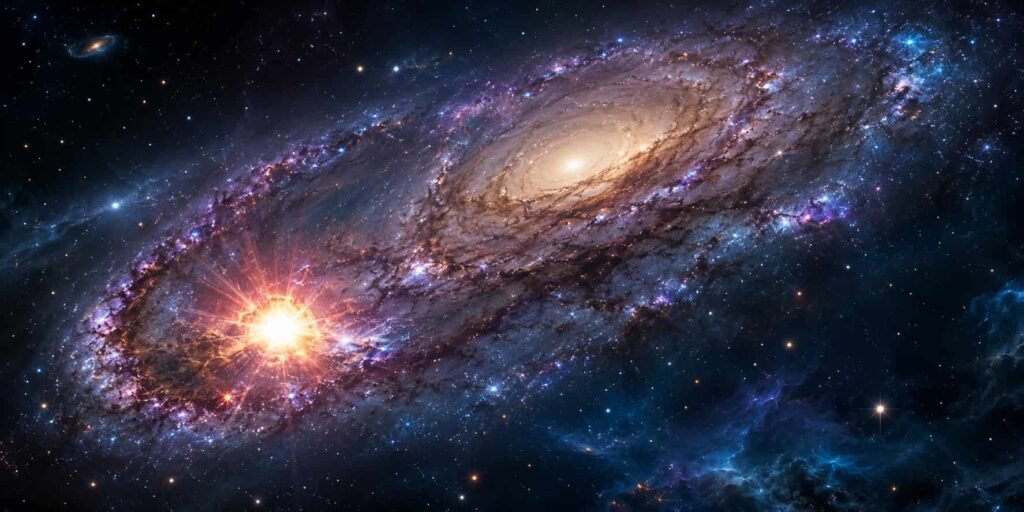
Over the last two decades, researchers have found that supernovae in older or more massive galaxies may look a little different from those found in younger or less massive galaxies. These differences matter because scientists use supernova brightness to measure huge cosmic distances.
To handle this issue, scientists have often used basic correction methods. These corrections are helpful, but they are not always detailed enough. If the adjustments are too simple, they can reduce the accuracy of distance measurements and affect the precision of cosmological studies.
Improving these corrections is important for understanding the expansion of the Universe, measuring cosmic acceleration, and studying dark energy more accurately.
A Complete Model for Supernovae and Cosmic Expansion
The new CIGaRS framework helps solve this problem by studying many important factors at the same time. Instead of looking at each part separately, the researchers created one integrated model that connects Type Ia supernovae, their host galaxies, cosmic dust, changes in supernova rates over time, and the expansion of the Universe.
This combined approach allows scientists to understand how these factors influence one another. For example, dust can change the light from a supernova, while the properties of a host galaxy can affect how that explosion is measured. When these details are studied together, researchers can produce more accurate cosmic distance measurements and improve their understanding of dark energy.
The model also uses Bayesian inference, a statistical method that helps scientists test many possible explanations at once. According to study co-author Raúl Jiménez from ICREA-ICCUB, simulating the Universe from the beginning inside a computer can help researchers explore different physical parameters and predict what kind of Universe best matches the data.
This method is also useful because it can reveal hidden sources of error, sometimes called unknown systematics. These are problems that may not be obvious at first but can still affect scientific results. By including these uncertainties in one statistical and physical framework, the team can make cosmological models more reliable and improve future research into cosmic expansion, supernova observations, and dark energy.
Read Also: Can SpaceX Run AI From Space? [Future Tech]How AI Helps Scientists Study the Universe
Creating a complete cosmic model usually needs a huge amount of computing power. To make this work easier and more practical, the researchers used a modern method called simulation-based inference.
The process starts by creating many simulated universes using trusted physical models. These simulations show how the Universe might behave under different conditions. After that, a neural network, which is a form of artificial intelligence, studies the simulated results and learns how astronomical observations are connected to the physical properties behind them.
Once the AI system is trained, it can compare real telescope data and supernova observations with the simulated examples. This helps scientists identify the most likely cosmological parameters, such as the values linked to cosmic expansion, dark energy, and the behavior of Type Ia supernovae.
This approach allows researchers to study tens of thousands of supernovae at the same time. That would be extremely difficult with older traditional techniques. By using simulation-based inference and machine learning, scientists can analyze massive astronomical datasets more efficiently and improve how they understand the cosmos.
Measuring Galaxy Distances Without Spectra
One of the most important results of the study is that the new CIGaRS framework can estimate galaxy distances with strong accuracy using only imaging data. This means scientists may not always need detailed spectroscopic observations to measure how far away a galaxy is.
The method focuses on redshift, which shows how much a galaxy’s light has been stretched as the Universe expands. A higher redshift usually means the galaxy is farther away and that we are seeing it as it looked much earlier in cosmic history.
According to the researchers, this new approach can produce redshift estimates that are close in accuracy to traditional spectroscopic measurements, even without using actual spectra. This is a major advantage because future sky surveys are expected to discover millions of supernova candidates.
However, only a small number of those candidates can be studied with expensive and time-consuming spectroscopic follow-up observations. By using imaging data, artificial intelligence, and simulation-based inference, the framework could help astronomers study far more Type Ia supernovae, improve cosmic distance measurements, and strengthen future research on dark energy and the expansion of the Universe.
Preparing for Rubin’s Massive Sky Survey
The Vera C. Rubin Observatory in Chile is expected to begin a major ten-year sky survey soon. During this long mission, it will scan the night sky in great detail and discover an enormous number of supernovae.
Most of these discoveries will not have detailed spectroscopic data. Instead, about 99% of the detected objects are expected to be observed photometrically, which means scientists will study them through images taken in different colors rather than through full spectra.
This creates a major challenge for astronomers. Future surveys will produce huge amounts of astronomical data, but traditional methods will not be able to study every object in detail. The CIGaRS framework was designed to solve this problem by using imaging data, artificial intelligence, and simulation-based inference to analyze large numbers of Type Ia supernovae more efficiently.
By preparing for the Rubin Observatory’s coming data deluge, this method could help researchers improve supernova classification, estimate redshifts, measure cosmic distances, and study the expansion of the Universe and dark energy with much larger datasets.
A Stronger Way to Study Rubin Observatory Data
According to Konstantin Karchev of ICCUB-SISSA Trieste, the lead author of the study, the new method is different from many older cosmology frameworks because it does not depend on major analytic simplifications.
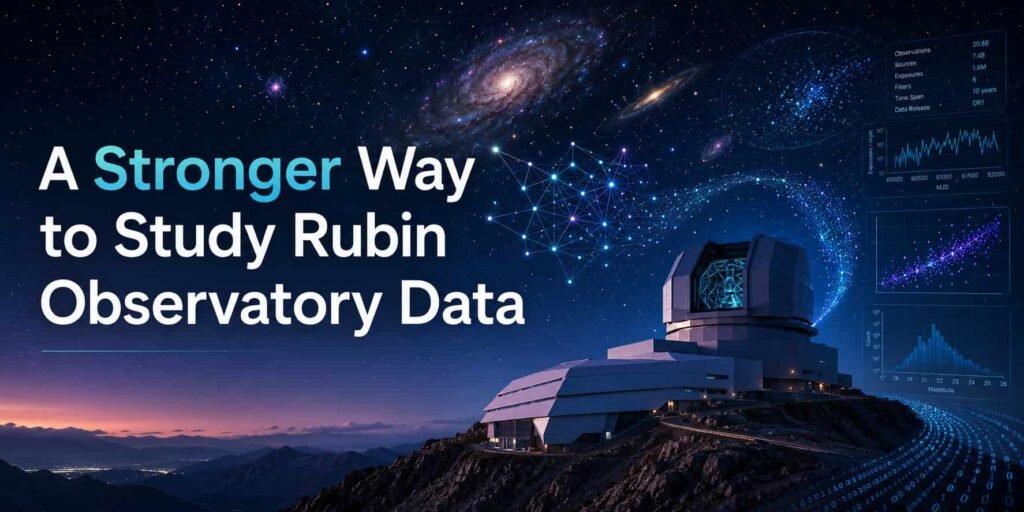
Instead, the team uses an end-to-end simulation-based inference approach. This allows the system to extract deeper cosmological information and astrophysical information from the massive datasets expected from the Vera C. Rubin Observatory.
Karchev explains that this approach can make better use of Rubin’s valuable astronomical data while reducing common problems such as selection bias and modelling bias. These biases can affect scientific results if certain supernovae, galaxies, or observational patterns are overrepresented or incorrectly modeled.
By avoiding these limitations, the CIGaRS framework may help researchers analyze Type Ia supernovae, estimate redshifts, improve cosmic distance measurements, and study dark energy and the expansion of the Universe with greater accuracy.
What Supernovae Can Reveal About Their Origins
The value of the CIGaRS framework goes beyond studying dark energy. It can also help scientists learn more about how Type Ia supernovae are formed.
By rebuilding how supernova rates change with the ages of stars in different galaxies, the model gives researchers a better way to study the systems that eventually create these powerful stellar explosions. This is important because scientists still have major questions about the exact conditions that lead to a Type Ia supernova.
The researchers found that combining physics-based simulations with artificial intelligence can solve several problems found in current cosmological methods. Their results suggest that this approach could improve cosmological constraints by up to four times compared with traditional methods that depend on smaller samples of spectroscopically observed supernovae.
As the Vera C. Rubin Observatory prepares to begin a new era of astronomical discovery, tools like CIGaRS could help scientists extract more useful information from its massive observational data. This could improve our understanding of supernova formation, cosmic expansion, dark energy, and the wider Universe.
Summary: Exploding Stars May Expose Dark Energy [Cosmic Clue]
Scientists have developed CIGaRS, a new AI-based framework that could improve how researchers study Type Ia supernovae and dark energy.The tool uses imaging data, simulation-based inference, and machine learning to analyze large numbers of supernovae more efficiently.It can estimate galaxy distances, redshifts, and cosmological parameters without relying heavily on costly spectroscopic observations.This is important for the Vera C. Rubin Observatory, which will produce massive amounts of astronomical data in its upcoming sky survey.Overall, CIGaRS may help scientists better understand cosmic expansion, supernova formation, and the true nature of the Univers