![Ape Laughter Hints at Human Speech [Hidden Origin]](https://giglegravity.site/wp-content/uploads/2026/07/Ape-Laughter-Hints-at-Human-Speech-Hidden-Origin.jpg)
Shared Rhythm Behind Ape and Human Laughter
Researchers found that living great apes and humans share a similar basic laughter rhythm. This suggests that human laughter may have deep evolutionary roots linked to the way our closest animal relatives communicate.
Although the core pattern is similar, human laughter has changed over time. It is now faster, more flexible, and strongly influenced by social interaction, emotions, and different communication situations. This means people use laughter not only as a natural reaction but also as a powerful part of social bonding, group behavior, and nonverbal communication.
The findings help scientists better understand how vocal expression, emotional signals, and human speech development may have evolved from earlier forms of ape communication.
Ancient Laughter Patterns May Explain How Human Speech Began
A new study from the University of Warwick suggests that the basic rhythm of human laughter may have remained almost unchanged for at least 15 million years. By studying and comparing the laughter of humans, chimpanzees, bonobos, gorillas, and orangutans, researchers found that this old vocal pattern could help explain how human speech slowly developed over time.
Scientists already know that humans are not the only primates that laugh. Other great apes also make laughter-like sounds during play, social contact, and emotional interaction. However, researchers have long wanted to understand how these ape vocalizations changed through evolution and whether they hold clues about the early roots of human language.
The findings suggest that laughter may be more than a simple emotional reaction. It may also be an important part of social communication, nonverbal expression, vocal behavior, and the long evolutionary path that eventually led to spoken language.
Great Ape Laughter Reveals an Ancient Rhythm Linked to Speech Evolution
Researchers studied laughter recordings from orangutans, gorillas, bonobos, chimpanzees, and humans to better understand the deep evolutionary roots of human communication. The study, published in Communications Biology, analyzed 140 laughter sequences from four orangutans, two gorillas, three bonobos, four chimpanzees, and four humans.
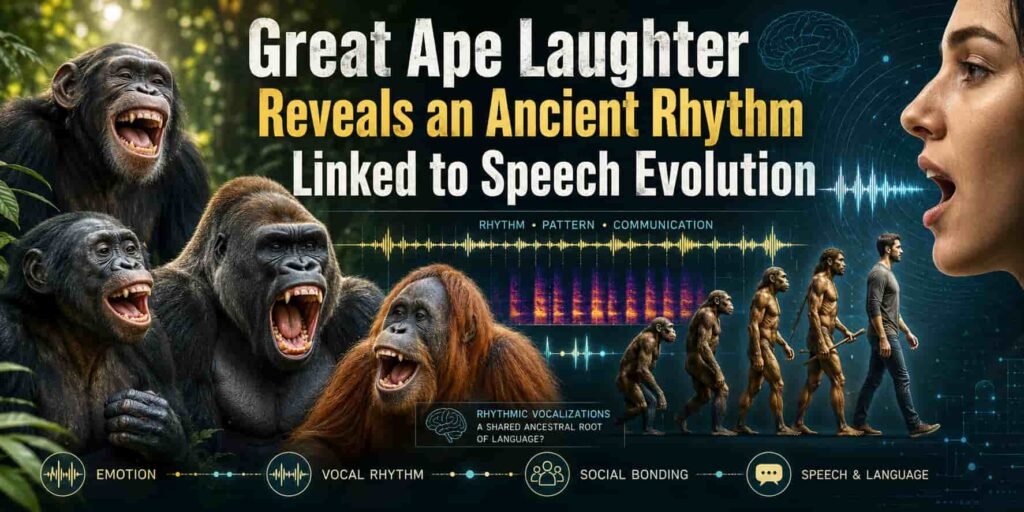
Although each species has its own way of producing laughter, the researchers found one important similarity. All five species created laughter with a steady rhythmic pattern, where the sounds were separated by regular time intervals. This shared rhythm suggests that the basic structure of great ape laughter may have come from a common ancestor that lived around 15 million years ago.
The researchers believe this ancient vocal rhythm has stayed surprisingly stable throughout the evolution of all living great apes. This discovery may help scientists understand how early vocal behavior, social communication, and emotional expression slowly contributed to the development of human speech.
Dr. Chiara De Gregorio, Honorary Research Associate in the Department of Psychology at the University of Warwick, explained that speech itself leaves no fossil record, making its origins difficult to study. However, because laughter is shared by humans and other great apes, it can provide rare evidence of how ancient vocal patterns may have shaped the path toward spoken language.
The findings suggest that laughter is more than a simple reaction to play or emotion. It may be an important evolutionary clue that connects ape communication, human laughter, speech development, language evolution, and nonverbal social interaction.
Human Laughter Became Faster and More Socially Adaptable
Although the basic rhythm of laughter appears to have remained stable over millions of years, human laughter has become faster, more diverse, and more flexible than the laughter of other great apes.
Humans can control their laughter depending on the social situation. A natural laugh caused by tickling is different from a polite laugh in a meeting, a nervous laugh after a mistake, or shared laughter among friends. Each type of laugh has a different social function, but all of them still follow the same basic rhythmic structure.
Researchers suggest that this improved ability to control vocal timing developed slowly during great ape evolution. Over time, stronger vocal control, including control over laughter, may have become an important foundation for the later development of human speech, spoken language, social communication, and emotional expression.
Read Also: Exploding Stars May Expose Dark Energy [Cosmic Clue]Laughter Offers Rare Clues About the Origins of Speech
Because spoken language does not leave behind direct fossil evidence, scientists have limited ways to study how human speech first began. However, laughter is much older than speech and is still shared by all living great apes, including humans, chimpanzees, bonobos, gorillas, and orangutans. This makes laughter an important clue for understanding how vocal communication changed during human evolution.
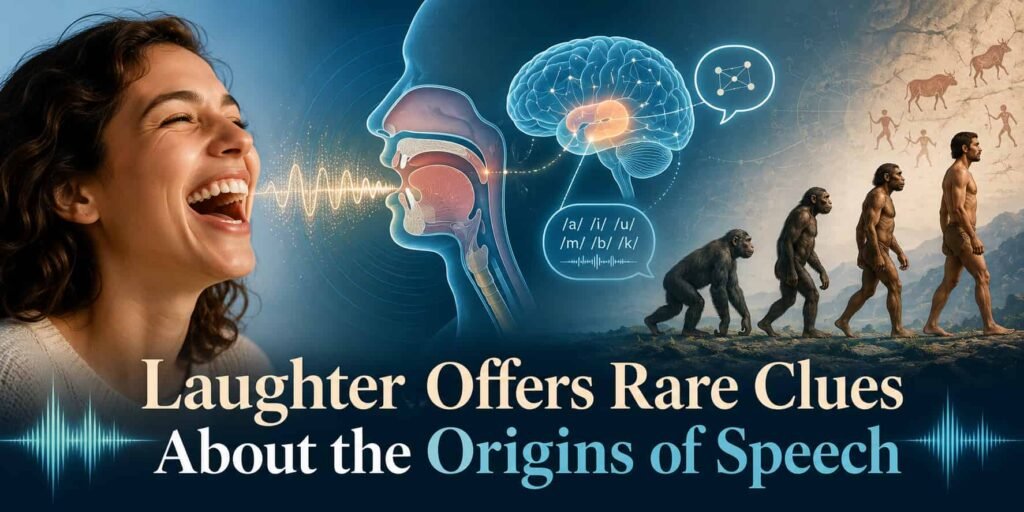
Dr. Adriano Lameria, Associate Professor in the Department of Psychology at the University of Warwick, explained that researchers cannot directly study the early forms of language used by extinct human ancestors. Instead, laughter gives scientists a rare view into the vocal changes that developed across hominid evolution before the first humans appeared.
The study challenges the older idea that humans suddenly developed completely new vocal control abilities. Instead, the findings suggest that human speech grew from abilities that were already developing slowly in earlier great ape ancestors. Over nearly 15 million years, these ancestors may have gradually improved their control over vocal rhythm, sound timing, emotional expression, and social communication.
In simple terms, human speech may not have appeared suddenly. It likely developed step by step from older ape vocal behaviors, with laughter acting as one of the clearest surviving signs of that long evolutionary process.
Summary: Ape Laughter Hints at Human Speech [Hidden Origin]
Researchers found that humans and all living great apes share a similar basic laughter rhythm, suggesting it may come from a common ancestor around 15 million years ago.Although this rhythm stayed stable, human laughter became faster, more flexible, and more shaped by social situations.Because speech leaves no fossil evidence, laughter gives scientists a rare way to study the early roots of human vocal communication.The study suggests that human speech likely developed gradually from older ape vocal behaviors, rather than appearing suddenly.