![Why Belly Fat Grows With Age [New Discovery]](https://giglegravity.site/wp-content/uploads/2026/07/Why-Belly-Fat-Grows-With-Age-New-Discovery.jpg)
Middle-Age Belly Fat May Begin at the Cellular Level
Scientists may have identified a hidden cellular switch that helps explain why belly fat often increases during middle age. The finding suggests that changes inside the body’s fat cells, metabolism, and aging process may play a key role in the rise of abdominal fat over time.
Aging May Trigger Belly Fat Through New Fat-Forming Cells
As people grow older, many notice that their waistline slowly becomes larger, even if their total body weight stays almost the same. This rise in abdominal fat is not only about appearance. Too much belly fat is linked to slower metabolism, faster aging, type 2 diabetes, heart disease, and other long-term health problems.
Experts have known for years that body composition changes with age. However, the exact reason why fat accumulation often happens around the midsection has not been fully clear.
A new study from City of Hope, published in Science, may help explain this process. Researchers found a newly identified type of stem cell that appears during aging and may increase the formation of new fat cells. This discovery suggests that age-related belly fat growth may be driven by changes at the cellular level. In the future, these findings could support new ways to reduce abdominal fat, improve metabolic health, and promote healthy aging.
Aging May Increase Belly Fat Even Without Weight Gain
According to Qiong “Annabel” Wang, Ph.D., co-corresponding author of the study and associate professor of molecular and cellular endocrinology at City of Hope’s Arthur Riggs Diabetes & Metabolism Research Institute, people often experience a shift in body composition as they get older. They may lose muscle mass and gain more body fat, even when their overall body weight stays the same.
The researchers found that aging may activate a new type of adult stem cell, which can increase the body’s production of new fat cells. This process appears to be especially active in the abdominal area, helping explain why belly fat often becomes more common in middle age.
Researchers Study How Aging Fat Tissue Keeps Growing
The research team, working with scientists from UCLA, carried out experiments in mice and later supported the results with studies using human cells.
The study focused on white adipose tissue, also called WAT, which is the body’s main fat-storage tissue. This tissue stores extra energy and plays an important role in weight gain, belly fat growth, and abdominal fat accumulation.
For a long time, scientists have known that existing fat cells can grow larger with aging. However, the researchers believed that another process might also be involved: the body may be making completely new fat cells.
This means that aging fat tissue may expand in two ways. It may increase the size of existing adipocytes, and it may also keep adding newly formed fat cells.
To explore this idea, the team studied adipocyte progenitor cells, or APCs. These are stem-like cells found inside fat tissue. They act as early-stage cells that can later develop into mature fat cells.
Aged Progenitor Cells Show Stronger Fat-Forming Activity
To understand how aging affects fat cell production, the researchers transplanted adipocyte progenitor cells, or APCs, from both young and older mice into another group of young mice.
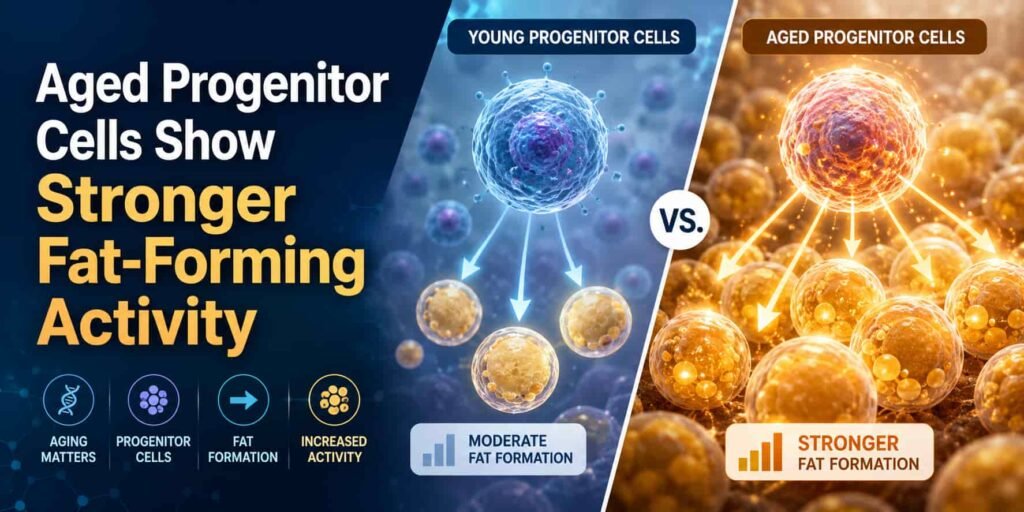
The results showed a clear difference. APCs taken from older mice produced a much higher number of new fat cells, suggesting that age changes how these stem-like cells behave.
When the researchers reversed the experiment, the outcome was different. APCs from young mice, when placed into older mice, created only a small number of new adipocytes. This suggests that older fat progenitor cells may have a stronger ability to drive fat tissue growth and abdominal fat accumulation.
Older Fat Progenitor Cells May Drive Belly Fat Growth
These results suggest that the strong fat-producing ability comes from the older adipocyte progenitor cells, or APCs, themselves. It did not seem to depend on whether the cells were placed in a young or old animal.
To study this process more closely, the researchers used single-cell RNA sequencing. This advanced method helps scientists study gene activity inside individual cells.
The results showed that APCs in young mice were mostly inactive. But in middle-aged mice, these cells became much more active and started producing many new fat cells.
Adolfo Garcia-Ocana, Ph.D., chair of the Department of Molecular and Cellular Endocrinology at City of Hope, explained that most adult stem cells lose their growth ability with age. However, APCs appear to do the opposite. Aging seems to activate these cells, allowing them to grow, spread, and create more fat tissue.
This finding provides important evidence that belly fat may increase with age because older APCs produce a high number of new adipocytes, especially in the abdominal area.
Read Also: Ape Laughter Hints at Human Speech [Hidden Origin]New Aging-Linked Stem Cells May Help Build Belly Fat
The researchers found that aging does more than make adipocyte progenitor cells, or APCs, more active. As mice entered middle age, some of these cells changed into a newly identified stem cell population called committed preadipocytes, age-specific, or CP-As.
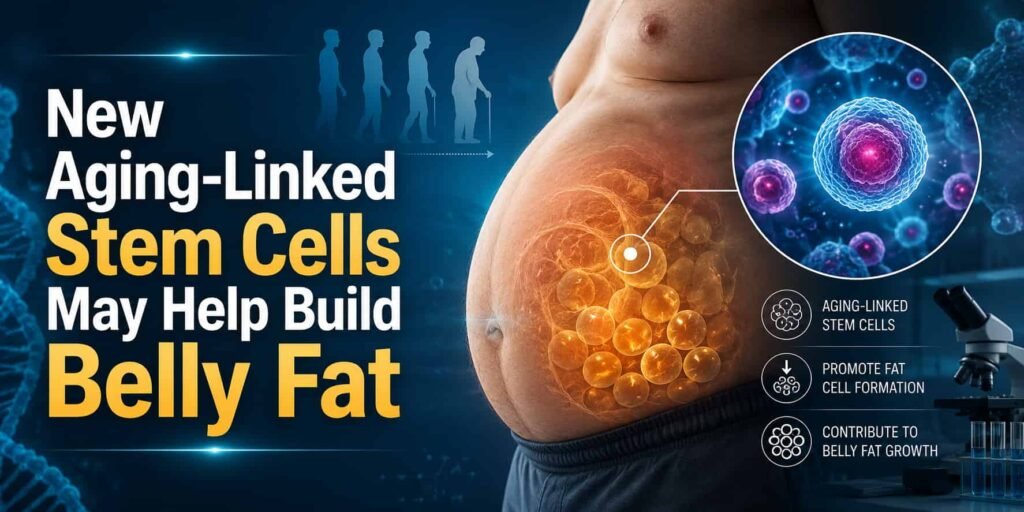
These CP-A cells appeared mainly during the aging process and were highly effective at producing new fat cells. This may help explain why older mice developed more body fat, especially around the belly.
The scientists then looked for the biological signals that control this fat-building process. They identified an important cell signaling pathway called the leukemia inhibitory factor receptor, or LIFR. Signaling pathways work like communication systems inside the body, helping cells receive instructions and decide how to behave.
In this study, LIFR signaling appeared to help CP-A cells grow, multiply, and turn into new adipocytes. According to Wang, young mice do not seem to need this signal to make fat, but older mice rely on it more strongly. The findings suggest that LIFR may be a key trigger behind age-related fat cell formation, belly fat expansion, and abdominal fat accumulation in older mice.
Human Fat Tissue Shows Similar Age-Linked Fat-Producing Cells
To see whether the same process may happen in humans, the researchers studied human tissue samples from people of different ages. They used single-cell RNA sequencing, the same method used in the mouse experiments, to examine gene activity in individual cells.
The team found human cells that were very similar to the newly identified CP-A cells. These cells appeared in higher numbers in tissue from middle-aged individuals.
The human CP-A-like cells also showed a strong ability to form new fat cells. This suggests that a similar biological process may contribute to age-related fat gain, belly fat accumulation, and changes in metabolic health in people.
According to Wang, controlling the formation of new adipocytes may be important for managing age-related obesity. A better understanding of CP-As, metabolic disorders, and how these cells appear during aging could help scientists develop new treatments to reduce abdominal fat, improve overall health, and support longevity.
New Treatment Target for Aging-Linked Belly Fat
Although further research is still needed, this discovery gives scientists a promising new therapeutic target for managing age-related obesity and belly fat accumulation.
The researchers now plan to study CP-A cells more closely in animal models, examine how these cells behave in human fat tissue, and explore possible ways to block, control, or remove them. If these approaches work, they may one day help reduce the buildup of abdominal fat that often happens during aging.
The study’s first authors were Guan Wang, Ph.D., from City of Hope, and Gaoyan Li, Ph.D., from UCLA.
Summary: Why Belly Fat Grows With Age [New Discovery]
Scientists found that belly fat may increase with age because of changes inside fat tissue, not just because existing fat cells grow larger.The study identified age-related APC and CP-A cells that can produce many new fat cells, especially around the abdomen.A key signal called LIFR may help these cells multiply and drive abdominal fat accumulation in older mice.Similar fat-producing cells were also found in middle-aged human tissue, suggesting the process may happen in people too.These findings could help scientists develop future treatments for age-related obesity, belly fat, and metabolic health problems.