![Alien Life May Be Quarantined on the Moon [Explained]](https://giglegravity.site/wp-content/uploads/2026/07/Alien-Life-May-Be-Quarantined-on-the-Moon-Explained.jpg)
Moon Base Could Protect Earth From Space Microbes
Scientists have proposed using the Moon as a protective barrier to reduce the risk of harmful extraterrestrial microbes reaching Earth.
A new space policy paper recommends that future NASA lunar bases should include a highly secure biocontainment facility. This specialised laboratory would safely store and examine potentially dangerous biological material collected during missions beyond Earth.
The main goal is to prevent unknown space microorganisms, alien life forms, or possible pathogens from entering Earth’s environment before scientists fully understand whether they pose a threat.
The proposal comes as space agencies prepare for increasingly advanced sample-return missions involving the Moon, Mars, asteroids, and other locations across the solar system.
By studying returned samples inside a controlled facility on the Moon, researchers could improve planetary protection, support safe space exploration, and reduce the risk of accidental biological contamination on Earth.
Lunar Laboratory Could Reduce Biological Risks From Space
As space exploration expands, scientists warn that current planetary protection measures may not be strong enough to manage the risks linked to bringing extraterrestrial samples back to Earth.
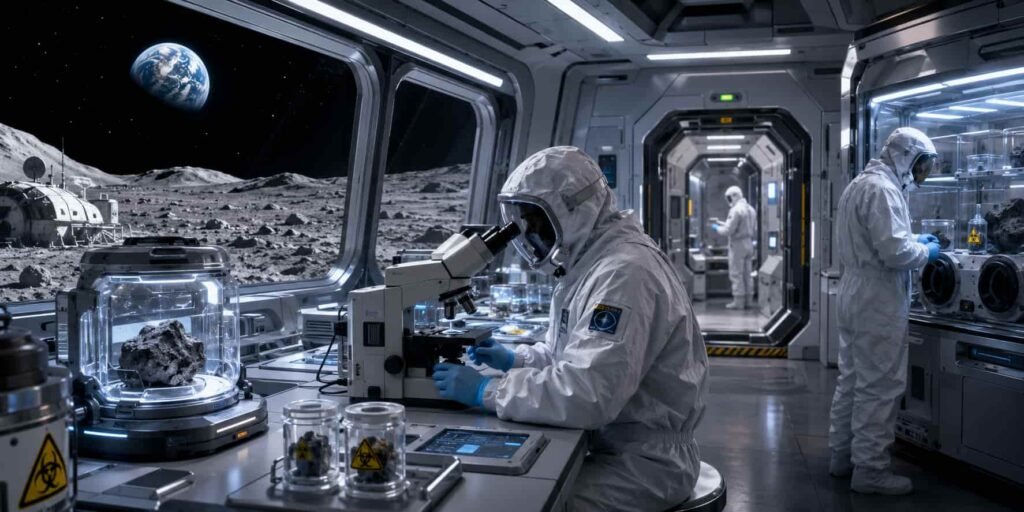
Frederick I. Moxley, co-author of the policy paper and Director of Strategic Threat Analysis and Research Laboratories, explained that a secure facility on the Moon could act as a protective barrier between Earth and any potentially dangerous living organisms carried by future missions.
The paper was written with Anthony Ricciardi, a professor of biology and Director of the Bieler School of Environment at McGill University.
Secure Lunar Quarantine for Returned Space Material
In the study, published in Ambio, the researchers propose that material collected from the Moon, Mars, asteroids, and other parts of the solar system should first be delivered to a highly secure lunar quarantine facility instead of being transported directly to Earth.
Inside this facility, advanced robotic systems would examine, test, and store the returned material without direct human contact. This approach could reduce the risk of human exposure, limit cross-contamination, and prevent unknown microorganisms or possible spaceborne pathogens from escaping into Earth’s environment.
The proposed Moon-based laboratory would strengthen biocontainment, improve sample-return mission safety, and provide scientists with a controlled location for studying possible extraterrestrial life before any material is allowed to reach Earth.
Why Unknown Space Organisms Could Pose a Serious Threat
Although scientists have not yet confirmed the existence of extraterrestrial life, they warn that introducing an unfamiliar organism into Earth’s biosphere could create unexpected and possibly harmful effects.
The researchers compare this danger with the impact of invasive species on Earth. History shows that even a small organism can spread rapidly when it enters a new environment without natural predators or controls. Such biological introductions can damage ecosystems, reduce biodiversity, disrupt food chains, and create long-term environmental problems.
Anthony Ricciardi, an expert in biological invasions, explained that decades of research have shown how organisms introduced into unsuitable environments can multiply uncontrollably. In some cases, the resulting ecological damage may be severe, permanent, and difficult to reverse.
For this reason, the researchers support a strong precautionary approach when handling materials that may contain organisms of extraterrestrial origin. They believe that possible risks should be carefully studied before any returned space samples are allowed to enter Earth’s environment.
Read Also: Scientists Build Quantum Sound Device [Future Tech]Expanding Space Missions Create New Safety Concerns
The proposal comes as global space activity continues to increase. National space agencies and private aerospace companies are launching more missions beyond Earth’s orbit, including projects involving the Moon, Mars, asteroids, and other parts of the solar system.
This growing competition has created a busier and more complicated space exploration environment. As more missions collect and return extraterrestrial samples, experts say stronger planetary protection, international cooperation, and clear biological safety protocols will be essential.
These measures could help reduce the risk of cross-contamination, protect Earth’s natural systems, and ensure that future sample-return missions are carried out responsibly.
Why Stronger Space Biosafety Is Becoming Essential
As space exploration grows rapidly, researchers say stronger biosafety measures and planetary protection protocols are becoming more important.
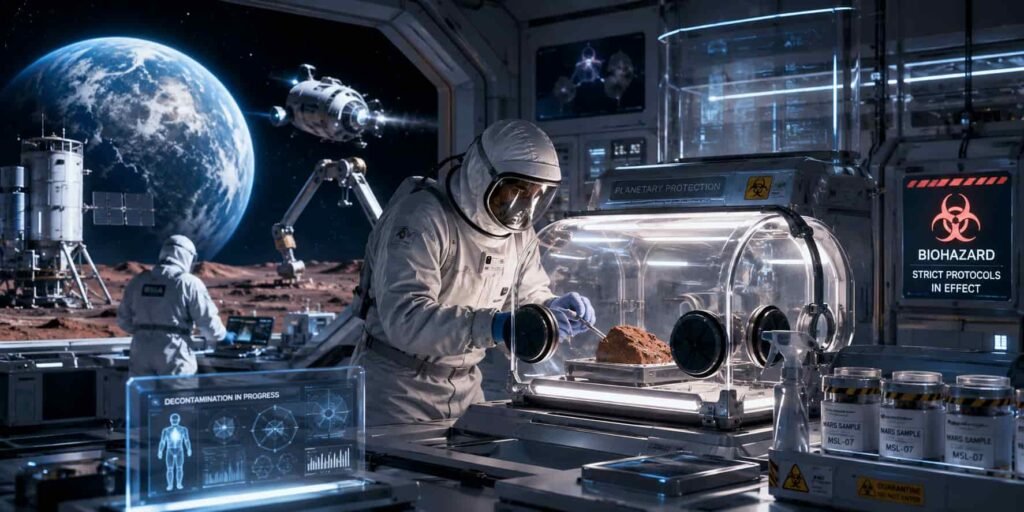
The study describes several serious emergency scenarios. These include a spacecraft accident involving contaminated samples or astronauts who may have been exposed to unknown extraterrestrial environments.
According to the authors, existing biocontainment facilities on Earth may not be able to guarantee the complete control, removal, or destruction of an unfamiliar alien microorganism after an accidental release. Because scientists would know very little about such an organism, predicting how it might behave in Earth’s environment could be extremely difficult.
The Moon Could Become Earth’s Biological Safety Barrier
The discovery of life beyond Earth could become one of the greatest scientific achievements in human history. However, the researchers argue that possible biological hazards must be carefully managed before extraterrestrial material is brought to our planet.
A secure lunar quarantine facility could allow scientists to examine returned samples at a safe distance from Earth. It could also reduce the risk of human exposure, accidental cross-contamination, and the uncontrolled spread of unknown spaceborne organisms.
For this reason, the researchers believe the Moon could serve as humanity’s first major biological defence system, protecting Earth while allowing scientists to continue the search for extraterrestrial life.
Read Also: Milky Way Glow May Reveal Dark Matter [Mystery]Summary: Alien Life May Be Quarantined on the Moon [Explained]
Scientists propose building a secure biocontainment facility on the Moon to examine extraterrestrial samples before they reach Earth.The facility would use advanced robotic systems to reduce human exposure and prevent accidental biological contamination.Researchers warn that unknown space organisms could behave unpredictably, much like invasive species introduced into new ecosystems.As sample-return missions increase, stronger planetary protection and biosafety measures are becoming essential.The Moon could therefore serve as Earth’s first major biological defence barrier against possible spaceborne threats.