![Milky Way Glow May Reveal Dark Matter [Mystery]](https://giglegravity.site/wp-content/uploads/2026/07/Milky-Way-Glow-May-Reveal-Dark-Matter-Mystery.jpg)
Milky Way Gamma-Ray Glow Raises New Dark Matter Questions
A visible-light image of the Milky Way shows the region where scientists have detected an unusual gamma-ray excess near the Galactic Center. This mysterious glow has remained one of the most debated questions in astrophysics for more than ten years. Researchers are still trying to understand whether the signal comes from ordinary cosmic objects or from dark matter.
Machine Learning Brings a Fresh Look at the Galactic Center Excess
Scientists from the University of Vienna and Lawrence Berkeley National Laboratory have used machine learning to study the Galactic Center Excess (GCE) in a new way. The GCE is a weak, nearly round glow of high-energy gamma rays around the center of our galaxy.
For years, researchers have argued about what may be causing this strange signal. Some believe it could come from many faint millisecond pulsars, while others think it may be linked to dark matter particles interacting or annihilating in space.
The new study, published in Physical Review Letters, suggests that dark matter is still a possible explanation. The findings do not prove that dark matter is responsible, but they show that the idea cannot yet be ruled out.
Why the Galactic Center Excess Matters
The Galactic Center Excess spreads across thousands of light-years around the core of the Milky Way. Because the glow is broad and difficult to separate from other cosmic radiation sources, scientists have proposed several possible causes.
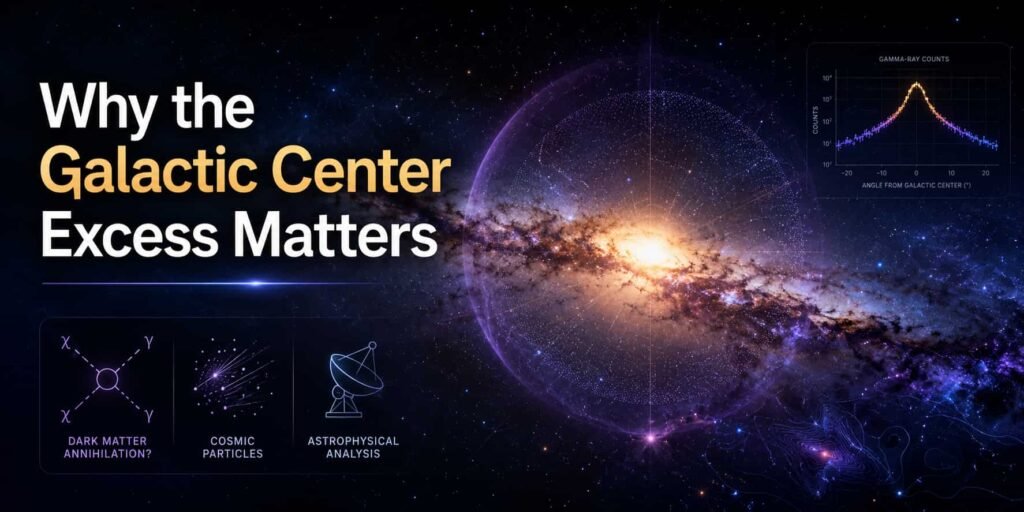
Understanding this signal could help researchers learn more about the structure of the Milky Way, the behavior of gamma-ray emissions, and the possible nature of dark matter, one of the biggest unsolved mysteries in modern space science.
Possible Sources of the Milky Way’s Gamma-Ray Signal
One possible explanation for the Galactic Center Excess is self-annihilating dark matter. This is a theoretical type of matter that may make up a large part of the universe’s mass, although scientists have not directly detected it yet.
Another major explanation points to a large group of millisecond pulsars. These are extremely fast-spinning neutron stars that release powerful high-energy radiation, including gamma rays.
Why the Signal Is So Hard to Explain
Even after many years of research, scientists still do not fully agree on what is creating this unusual gamma-ray glow near the center of the Milky Way.
According to Florian List, a researcher at the University of Vienna and one of the study authors, the signal is difficult to study because the Galactic Center is one of the brightest and most crowded areas in the gamma-ray sky. This makes it hard to separate the true source of the excess radiation from other nearby cosmic objects and background emissions.
Read Also: Exploding Stars May Expose Dark Energy [Cosmic Clue]Machine Learning Reveals New Clues About the Gamma-Ray Mystery
Earlier statistical studies mostly supported the idea that the Galactic Center Excess may come from millisecond pulsars. However, those studies missed an important detail: the energy level of each gamma-ray photon detected from the center of the Milky Way.
To improve the analysis, researchers created a machine-learning model and trained it using more than one million simulated gamma-ray observations. This new method studied two important features at the same time: the spatial pattern of the signal and the photon energy data from individual gamma rays.
The researchers found that adding photon energy information changes the interpretation in a major way.
Fainter Sources Make the Dark Matter Theory Harder to Reject
Previous research suggested that the signal could come from unresolved point sources, meaning small light sources that are too close together or too weak to be seen separately. Earlier models often assumed these sources were relatively bright.
The new machine-learning analysis suggests something different. If point sources are responsible for the gamma-ray excess, they would have to be extremely faint.
According to Nick Rodd, a scientist at Lawrence Berkeley National Laboratory, the new results show that these sources would be so weak that their emission would look almost the same as the signal expected from annihilating dark matter.
Pulsar Explanation Faces a Bigger Challenge
The findings also make the pulsar theory more difficult to prove. If millisecond pulsars are causing the glow, the study suggests that at least 35,000 pulsars would need to exist near the center of the Milky Way.
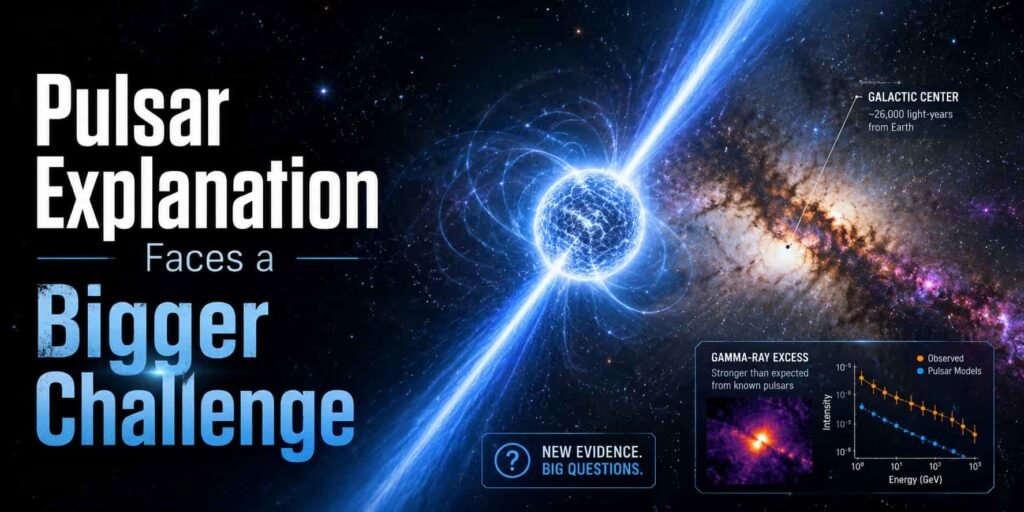
That number is much higher than earlier estimates, which often suggested only a few hundred to a few thousand hidden sources. This means the dark matter explanation remains possible, and scientists cannot yet dismiss it as the source of the Galactic Center gamma-ray signal.
Dark Matter Remains a Serious Possibility
The Galactic Center Excess is still one of the most debated mysteries in astrophysics. According to Florian List, the new research does not prove that dark matter is causing the signal. However, it shows that scientists should not reject this explanation too soon.
The latest findings weaken one of the main arguments previously used against the dark matter theory. Although the study does not provide direct proof that dark matter particles are producing the unusual gamma-ray glow, it suggests that this idea remains scientifically possible.
Read Also: Can SpaceX Run AI From Space? [Future Tech]The Milky Way Mystery Is Still Unsolved
For now, researchers still do not know the true source of the Galactic Center Excess. The signal could come from hidden astrophysical sources, such as millisecond pulsars, or it may be connected to dark matter annihilation.
Until stronger evidence is found, the mysterious gamma-ray emission near the center of the Milky Way will remain one of the most important open questions in modern space science and astronomy.
Summary: Milky Way Glow May Reveal Dark Matter [Mystery]
The Milky Way’s Galactic Center shows an unusual gamma-ray glow that scientists still cannot fully explain.A new machine-learning study suggests that dark matter remains a possible source of this signal.The research found that if hidden point sources or millisecond pulsars are responsible, they would need to be extremely faint or unusually numerous.This makes the pulsar explanation harder to prove and keeps the dark matter theory scientifically alive.For now, the true cause of the Galactic Center Excess remains unsolved.