![Climate Expert Says Report Got It Wrong [New Warning]](https://giglegravity.site/wp-content/uploads/2026/07/Climate-Expert-Says-Report-Got-It-Wrong-New-Warning.jpg)
Climate Scientist Challenges Errors in a US Government Report
A leading climate scientist has disputed claims made in a major US government climate report, arguing that the document misunderstood his research and weakened the scientific evidence linking human activity to global warming.
Professor Benjamin Santer, an Honorary Professor at the University of East Anglia, described some of the report’s conclusions as scientifically incorrect. He has presented new evidence to clarify his findings and correct what he believes is a misleading interpretation of established climate research.
Research Identified Humanity’s Climate Fingerprint
Professor Santer was among the first scientists to detect a clear human fingerprint in the Earth’s climate system. His research examined long-term patterns in atmospheric temperature and showed that these changes could not be explained by natural causes alone.
His work played an important role in the Intergovernmental Panel on Climate Change’s 1995 assessment. That report marked a major moment in climate science because it concluded that there was sufficient evidence of a discernible human influence on the global climate.
The findings strengthened the scientific understanding that rising greenhouse gas emissions, especially those produced by burning fossil fuels, are changing global temperatures. Santer’s latest response aims to protect the accuracy of this evidence and prevent political reports from misrepresenting established climate science.
Climate Science Report Raises Policy Concerns
In July 2025, the US Department of Energy released a report that referred to research by Professor Ben Santer but used it to support a conclusion that climate scientists say was incorrect. The report appeared on the same day the US Environmental Protection Agency proposed reversing the 2009 endangerment finding.
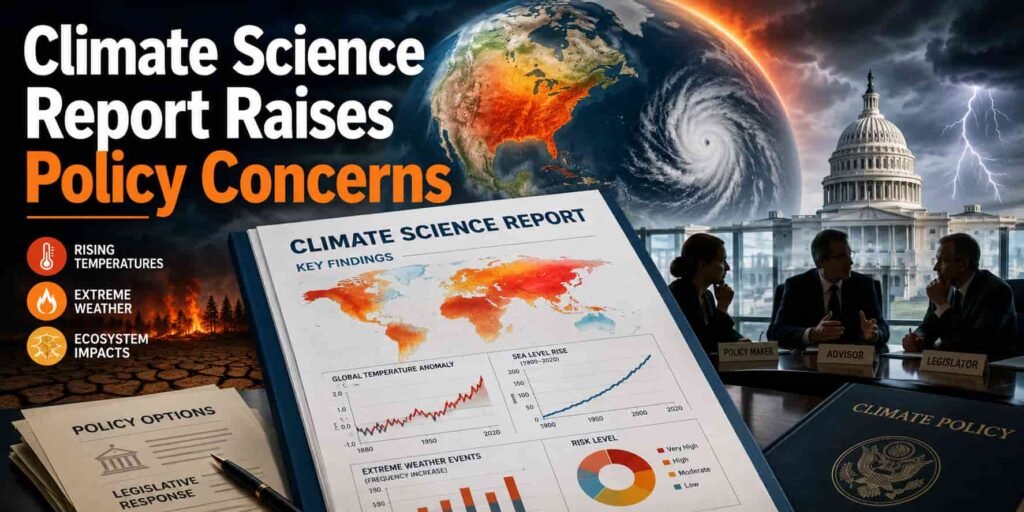
The endangerment finding is important because it gives the EPA the legal power to control greenhouse gas emissions from vehicles, power plants, and other industrial sources. The Trump administration later moved ahead with plans to revoke the finding. This raised concerns among scientists, health experts, and environmental groups about possible harm to public health, climate regulation, and wider environmental protections in the United States.
Scientists Reaffirm the Human Cause of Global Warming
A new study published in AGU Advances has responded directly to the DOE report. In the paper, Professor Santer worked with leading climate scientists, including Professor Susan Solomon of MIT, Professor David Thompson of UEA and Colorado State University, and Professor Qiang Fu of the University of Washington.
The researchers restated the strong scientific evidence that human activity is the main driver of global warming. They also argued that the DOE report should not be used to support legal or political decisions about climate policy, especially decisions linked to the endangerment finding.
Professor Santer said it was important to correct the scientific record when an official government report makes an incorrect claim. He explained that peer-reviewed science must be used carefully, especially when it may influence major decisions about greenhouse gases, carbon dioxide, and environmental law.
Atmospheric Evidence Supports Human-Caused Climate Change
The scientists focused on what they call the temperature fingerprint of human influence on the climate. This means the pattern of temperature change seen in different layers of the atmosphere.
One key sign is the warming of the troposphere, which is the lowest layer of the atmosphere where weather happens. At the same time, the stratosphere, the layer above it, is cooling. Scientists say this pattern is mainly caused by rising levels of CO2 and other greenhouse gases from human activities.
The study states that satellite observations match modern climate model results. Both show the same clear pattern: the lower atmosphere is warming, the upper atmosphere is cooling, and this is consistent with human-caused climate change.
Satellite Evidence Supports the Human Influence on Climate
Scientists have predicted the clear human fingerprint on climate for more than 50 years using both basic and advanced climate models. This distinctive pattern can also be identified in satellite temperature records, providing strong evidence that human activities are affecting the Earth’s atmosphere.
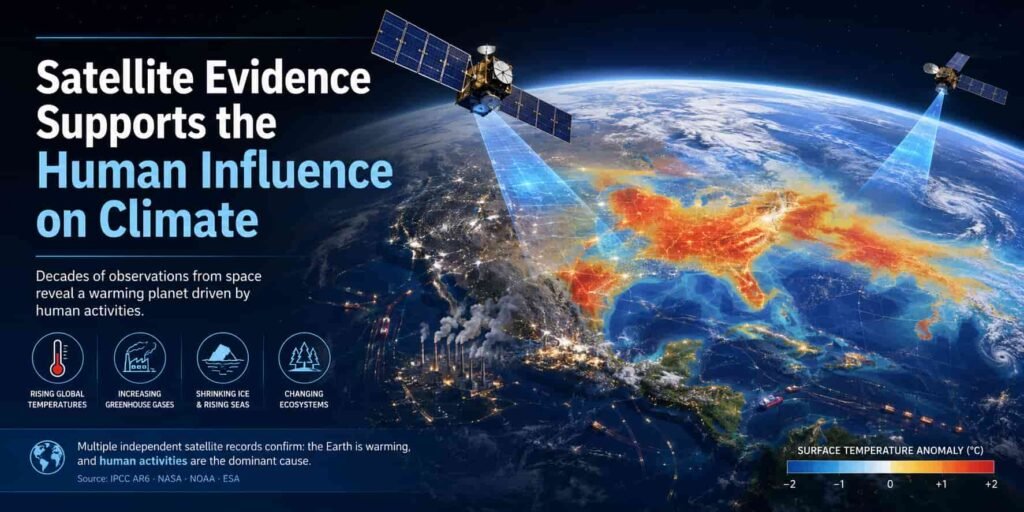
Professor Benjamin Santer argued that the US Department of Energy climate review incorrectly questioned this evidence. According to the researchers’ analysis, the DOE report does not provide an accurate explanation of how temperatures are changing at different levels of the atmosphere.
The vertical pattern of atmospheric temperature change is particularly important because it helps scientists distinguish between natural climate variation and warming caused by human-produced greenhouse gas emissions. For this reason, the researchers concluded that the DOE document should not be treated as a dependable source on this area of climate science.
Wider Scientific Concerns Surround the DOE Review
The researchers also highlighted concerns about other sections of the report, particularly its discussion of climate change detection and attribution. Detection examines whether the climate has changed beyond normal natural variation, while attribution identifies the factors responsible for those changes.
The report also had an influence beyond the Department of Energy. It was referenced 16 times in an Environmental Protection Agency proposal, raising concerns that disputed scientific claims could affect future environmental policy and climate regulation.
Read Also: This Pesticide Could Erase Future Bumblebees [Warning]Disputed Report Remains Publicly Available
A legal case later claimed that the DOE had not followed the required procedures of the Federal Advisory Committee Act when preparing the review. Following the lawsuit, the group responsible for producing the report was dissolved in early September.
Despite this development, the document has not been officially withdrawn, revised or corrected. It remains available on the DOE website and continues to be presented publicly as a reliable source of climate information.
Professor Santer strongly rejected this description, maintaining that the report contains serious scientific errors and should not be used as a credible guide to the evidence surrounding human-caused global warming.
Summary: Climate Expert Says Report Got It Wrong [New Warning]
Professor Benjamin Santer challenged a US Department of Energy climate report, saying it misunderstood his research and made incorrect claims about human-caused climate change.His work shows a clear human fingerprint in the atmosphere: the troposphere is warming while the stratosphere is cooling, a pattern linked to rising CO2 and other greenhouse gases.A new AGU Advances paper by Santer and other climate scientists argues that the DOE report should not be used to guide climate policy or decisions about the EPA endangerment finding.Although legal concerns led to the report’s review group being dissolved, the document remains publicly available, which scientists say could mislead the public and weaken environmental protections.