![New Weight Loss Pill Beats Oral Ozempic [Major Trial]](https://giglegravity.site/wp-content/uploads/2026/07/New-Weight-Loss-Pill-Beats-Oral-Ozempic-Major-Trial.jpg)
New Oral Drug Shows Strong Weight-Loss Results
A new once-daily weight-loss pill has produced better results than existing oral treatments in a recent clinical trial. The medicine, called orforglipron, helped participants lose more weight while also improving blood sugar control.
Researchers believe the drug could become an important option in the growing market for oral obesity treatments. Unlike injectable medicines, orforglipron is taken as a tablet, which may make treatment more convenient for people who prefer not to use injections.
However, its long-term success may depend on whether patients can continue taking it regularly. Treatment adherence, side effects and the ability to maintain weight loss will be important factors in determining how effective the medicine is outside clinical trials.
Weight-Loss Medicines Enter a New Phase
The arrival of semaglutide, sold under brand names such as Wegovy and Ozempic, significantly changed the treatment of obesity and type 2 diabetes. These injectable medicines showed that drugs targeting appetite and metabolism could lead to substantial weight loss.
Orforglipron may represent the next stage in this development by offering similar benefits in pill form. A successful oral treatment could improve access, simplify daily use and increase competition within the expanding weight-management drug market.
How GLP-1 Medicines Support Weight Loss and Diabetes Control
Semaglutide belongs to a group of medicines called glucagon-like peptide-1 receptor agonists, or GLP-1 drugs. These treatments copy the effects of a natural gut hormone that is released after a person eats.
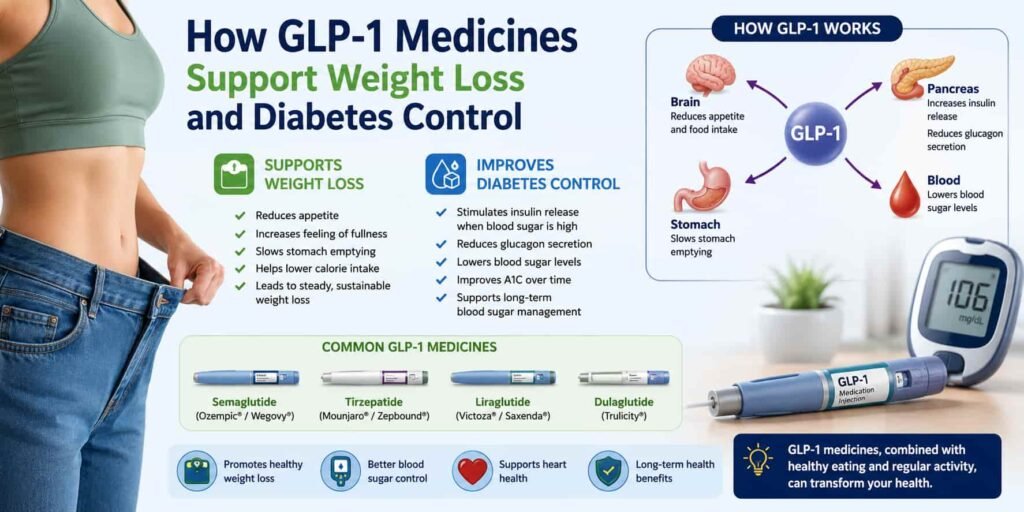
This hormone sends signals of fullness to the brain, slows the movement of food through the stomach and supports the release of insulin. By reproducing these actions, GLP-1 medicines can help control blood glucose levels, reduce appetite and support meaningful weight loss in people with type 2 diabetes or obesity.
Why Injectable Treatments Can Be Difficult to Use
Although semaglutide is widely prescribed, most versions must be injected into the abdomen, thigh or upper arm. This can be uncomfortable or inconvenient for people who dislike needles, have needle anxiety or do not feel confident giving themselves injections.
Injectable GLP-1 medicines also need to remain refrigerated during storage and transportation. Maintaining this cold supply chain can be difficult and expensive, especially in low-income and middle-income countries where reliable refrigeration may not always be available.
These practical problems have encouraged pharmaceutical researchers to develop effective oral GLP-1 treatments that can be taken as tablets.
Limitations of Existing Oral Semaglutide
Research suggests that oral semaglutide can improve diabetes control and support weight reduction. However, the medicine must usually be taken on an empty stomach, and patients must avoid eating or drinking for at least 30 minutes afterwards.
This strict routine may make it harder for some people to take the treatment correctly every day. Oral semaglutide is also costly to manufacture and has relatively poor bioavailability.
Bioavailability describes how much of a medicine enters the bloodstream and becomes active in the body. In the case of oral semaglutide, only around 1% of the swallowed dose is absorbed. This is much lower than the absorption achieved through injectable treatment.
A New Daily Tablet May Offer an Alternative
A recent phase 3 clinical trial examined whether a newer oral medicine called orforglipron could overcome some of these limitations. The treatment is taken once a day and may be more effective than currently available oral semaglutide products.
The 52-week study included 1,698 adults with type 2 diabetes from six different countries. Researchers compared the effects of orforglipron with existing oral semaglutide treatments.
The main outcome was the change in HbA1c, a blood test that measures a person’s average blood sugar level over the previous two to three months. HbA1c is widely used to assess diabetes management, and a result of 6.5% or higher is generally used as a diagnostic threshold for diabetes.
Read Also: Daily Music Linked to Lower Dementia Risk [Study]Orforglipron Delivered Stronger Blood Sugar and Weight Results
Participants began the study with an average HbA1c level of 8.3%. After 52 weeks, orforglipron reduced HbA1c by an average of 1.71% to 1.91%. By comparison, oral semaglutide produced an average reduction of 1.47%.
These findings showed that orforglipron was not only comparable with oral semaglutide but also more effective at improving blood glucose control. This suggests that the new daily tablet may offer meaningful benefits for people managing type 2 diabetes.
Orforglipron also produced greater weight loss. Depending on the dose, participants lost an average of 6.1 to 8.2 kilograms, while those taking oral semaglutide lost around 5.3 kilograms.
Digestive Side Effects Remain a Major Concern
Despite its stronger results, the trial raised concerns about treatment tolerability. Like other GLP-1 medicines, orforglipron can cause gastrointestinal side effects, including nausea, vomiting, diarrhoea and constipation.
Around 59% of participants taking orforglipron reported digestive symptoms. In comparison, these side effects affected approximately 37% to 45% of participants using oral semaglutide.
Researchers suggested that the higher rate of symptoms may be linked to the stronger daily peaks in drug concentration produced by orforglipron. These peaks may increase the medicine’s effects but could also make unwanted reactions more noticeable.
More Patients Stopped Orforglipron Treatment
Side effects caused about 10% of participants taking orforglipron to stop treatment. The discontinuation rate among oral semaglutide users was lower, at around 4% to 5%.
This difference is important because a medicine can only remain effective when patients are able and willing to take it regularly. Therefore, patient adherence, long-term safety and the management of adverse effects may determine whether orforglipron succeeds in routine healthcare.
Comparison With Injectable GLP-1 Medicines
Researchers have not yet conducted a direct head-to-head clinical trial comparing orforglipron with injectable GLP-1 treatments. However, the weight loss recorded among participants with type 2 diabetes was broadly similar to results previously reported for some injectable GLP-1 medicines.
Further research is needed to compare these treatments directly and assess their long-term effects on body weight, diabetes control, treatment adherence and overall health.
Orforglipron Could Reshape the Oral Weight-Loss Market
The trial results suggest that orforglipron, developed by Eli Lilly, could become one of the strongest competitors to semaglutide in the growing market for oral weight-loss medicines and type 2 diabetes treatments.
One of the drug’s most important features is that it belongs to a newer class known as small-molecule medicines. These are synthetic chemical compounds that are small enough to pass directly through the intestinal wall and enter the bloodstream.
Once absorbed, orforglipron activates GLP-1 receptors, even though its chemical structure does not closely resemble the body’s natural GLP-1 hormone. This may make the medicine easier to manufacture, store and take compared with some peptide-based treatments.
By contrast, oral semaglutide is a peptide drug. Peptides are made from chains of amino acids, which are the basic building blocks of proteins. The structure of semaglutide is designed to closely copy the natural GLP-1 hormone produced by the body.
This difference in drug design could have major market implications. Small-molecule treatments may offer simpler production, easier transport and more convenient dosing, although their long-term safety, cost and patient tolerability will still require careful evaluation.
Read Also: Nearly Half of Kidney Patients Never Start [Shocking]Lower Production Costs and Easier Distribution
As a small-molecule medicine, orforglipron is generally easier and less expensive to manufacture than peptide-based drugs such as semaglutide. Its simpler chemical structure may allow pharmaceutical companies to produce it more efficiently and at a larger scale.

Like oral semaglutide, orforglipron does not require refrigerated storage. This gives the tablet an important advantage over injectable GLP-1 medicines, which must remain cold during transportation and storage.
Avoiding refrigeration could make the drug easier to distribute in low-income and middle-income countries, where reliable cold-chain infrastructure may be limited. It could therefore support wider access to treatments for type 2 diabetes, obesity and long-term weight management.
Side Effects Could Influence Market Success
Despite its promising clinical results, it is not yet clear how successfully orforglipron will compete with oral semaglutide in everyday healthcare.
The latest trial found that orforglipron produced greater improvements in blood sugar control and weight reduction. However, it was also linked to higher rates of gastrointestinal side effects and more patients stopping treatment.
These concerns may reduce enthusiasm among patients and healthcare professionals. In the competitive weight-loss drug market, effectiveness alone may not determine which medicine becomes most widely used.
Long-term treatment adherence is likely to be a major factor. Patients are more likely to continue using a medicine when it provides strong results without causing difficult or persistent adverse effects. Therefore, tolerability, convenience, affordability and clinical effectiveness will all influence orforglipron’s future position.
Researchers are continuing to test orforglipron in people living with obesity without diabetes. These studies will provide further evidence about its safety, effectiveness and potential use among a wider patient population.
Summary: New Weight Loss Pill Beats Oral Ozempic [Major Trial]
Orforglipron is a once-daily oral GLP-1 medicine that reduced blood sugar and body weight more than oral semaglutide in a 52-week trial.Participants lost around 6.1 to 8.2 kilograms, while HbA1c levels fell by up to 1.91%.However, gastrointestinal side effects were more common, causing more patients to stop treatment.Its small-molecule design may make it cheaper to manufacture, easier to store and simpler to distribute without refrigeration.Its future success will depend on long-term tolerability, affordability, safety and patient adherence.