![New X-Ray Detector 1,000x More Sensitive [Breakthrough]](https://giglegravity.site/wp-content/uploads/2026/07/New-X-Ray-Detector-1000x-More-Sensitive-Breakthrough.jpg)
Europe’s First Synchrotron-Based TES X-Ray Spectrometer Begins Operation
A powerful new X-ray research instrument has started working at BESSY II. The system was developed through a joint effort by HZB, MPI-CEC in Mülheim an der Ruhr, Germany, and NIST in Boulder, Colorado, USA. It is now the first and only TES spectrometer operating at a synchrotron facility in Europe.
The instrument uses highly sensitive superconducting sensors that must be cooled to temperatures below 25 millikelvin. To reach this extreme cold, scientists use a helium-4/helium-3 dilution refrigerator, similar to the cooling systems used in many quantum computers.
This new transition-edge sensor spectrometer gives researchers a major advantage in photon detection. Compared with traditional wavelength-dispersive X-ray emission spectrometers, it can detect X-ray photons 100 to 1000 times more efficiently.
Scientists plan to use the system to study the electronic structure of atomically thin materials, nanostructures, and very small or highly diluted atomic and molecular samples. These capabilities could help researchers better understand advanced materials, chemical systems, and future quantum technologies.
The research team is now accepting scientific proposals from researchers who want to use this advanced X-ray spectroscopy tool for new experiments.
A More Sensitive Method for X-Ray Spectroscopy
BESSY II produces extremely bright synchrotron X-rays, allowing scientists to examine many types of materials in great detail. However, advanced methods such as X-ray emission spectroscopy (XES) and Resonant Inelastic X-ray Scattering (RIXS) have one major limitation: they depend on detecting photons released from the sample.
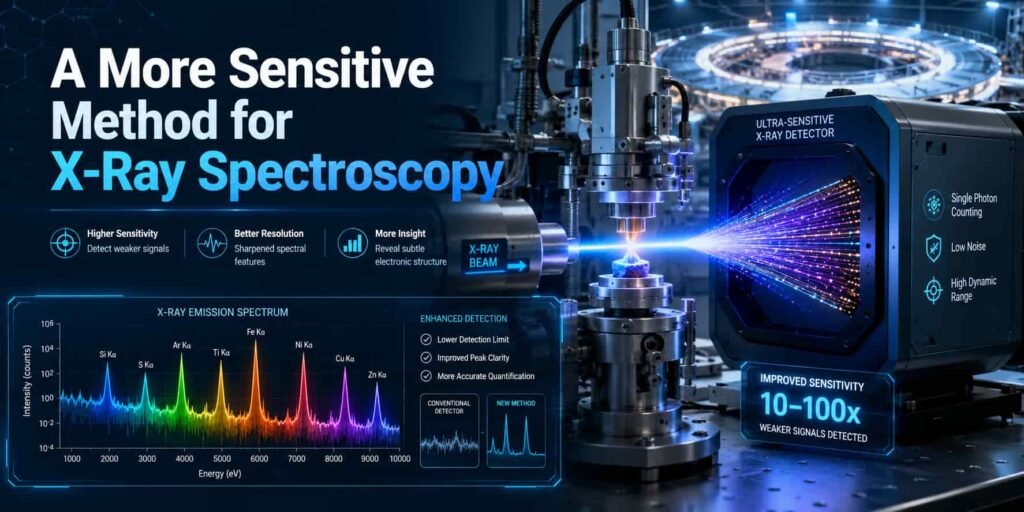
Because only a small number of useful photons may come from some samples, these techniques usually need a very strong photon signal to produce accurate results. For this reason, XES and RIXS experiments have mostly been used for bulk materials or samples with high concentration.
The new superconducting Transition Edge Sensor (TES) array at BESSY II helps solve this problem. According to Régis Decker of HZB, the new photon detector is about 100 to 1000 times more efficient at detecting photons than traditional XES and RIXS spectrometers.
This higher detection efficiency can make it possible to study much smaller, thinner, or more diluted samples than before, opening new opportunities in X-ray spectroscopy, material science, and nanostructure research.
Advanced Research in Quantum Materials and Ultra-Thin Structures
The higher sensitivity of the new TES spectrometer allows scientists to study materials and systems that were once very hard, or even impossible, to examine with older instruments.
According to Régis Decker, this technology can help researchers gain deeper knowledge of molecular chemistry, molecular biology, and the quantum properties of extremely small systems. These include atomic monolayers, nanostructures, impurities, and other low-dimensional materials.
The instrument also works well alongside techniques such as ARPES, which is used to map the electronic band structure of materials. Together, these methods can give scientists a clearer view of how electrons behave in advanced quantum systems.
Another major benefit is speed. Many X-ray emission spectroscopy and Resonant Inelastic X-ray Scattering experiments that once took several hours can now be completed in only a few minutes. This makes research faster, more efficient, and more practical for studying delicate or rare samples.
Read Also: Physicists Reveal Fractional Fermi Sea [Quantum]Ultra-Cold Superconducting Sensors for X-Ray Detection
The TES array spectrometer uses 248 superconducting sensors that operate at an extremely low temperature of 25 milli-Kelvin, close to absolute zero. To reach this temperature, scientists use a He4-He3 dilution refrigerator, a cooling system similar to those used in advanced quantum computing technologies.
The detection process begins when X-rays hit a sample and cause it to release photons. These photons then strike individual sensors in the TES array. Each photon creates a tiny but sudden rise in temperature inside the sensor.
This short temperature increase interrupts the sensor’s superconducting state and causes its electrical resistance to rise. Scientists measure this resistance change using sensitive electronic circuits based on Superconducting Quantum Interference Devices, also known as SQUIDs.
This setup allows the instrument to detect very small amounts of X-ray emission with high precision, making it useful for studying advanced materials, quantum systems, and delicate scientific samples.
Precision Sample Control and Planned Instrument Enhancements
The spectrometer is linked to a specially designed ultra-high vacuum sample chamber, which allows scientists to safely transfer, prepare, and measure samples under highly controlled conditions. This chamber also offers accurate temperature control, ranging from 10 Kelvin to room temperature, making it suitable for studying sensitive materials in different thermal environments.

The full system is installed at the BESSY II UE52-SGM beamline, which provides complete polarisation control for advanced X-ray spectroscopy experiments. Future improvements are planned to expand the instrument’s sample preparation features and allow studies of materials under magnetic fields.
These upgrades will support advanced techniques such as X-ray Magnetic Circular Dichroism in absorption, known as XMCD, and magnetic studies using Resonant Inelastic X-ray Scattering, including RIXS-MCD. This will help researchers better understand the magnetic properties, electronic structure, and quantum behavior of advanced materials.
Europe’s First Synchrotron-Based TES Spectrometer
TES spectrometers were first developed for astrophysics, where scientists need to detect extremely weak photon signals from distant objects in space. Their high sensitivity makes them useful for measuring very small amounts of X-ray emission with great accuracy.
Before the new system was installed at BESSY II, only five TES spectrometers were operating at X-ray research facilities around the world. Four were located in the United States, and one was in Japan.
With this installation, BESSY II now operates the only synchrotron TES spectrometer in Europe. This gives European researchers a powerful new tool for advanced X-ray spectroscopy, photon detection, materials science, molecular research, and quantum material studies.
Régis Decker said the team is excited to receive new and promising research proposals from the scientific user community.
Read Also: Exploding Stars May Expose Dark Energy [Cosmic Clue]Summary: New X-Ray Detector 1,000x More Sensitive [Breakthrough]
BESSY II has started operating Europe’s first synchrotron-based TES X-ray spectrometer.The instrument uses 248 ultra-cold superconducting sensors to detect X-ray photons with 100 to 1000 times higher efficiency than traditional systems.This allows scientists to study thin materials, nanostructures, diluted samples, molecular systems, and quantum materials more easily.It can also reduce some XES and RIXS experiments from hours to just minutes.Future upgrades will support magnetic-field studies, including XMCD and RIXS-MCD experiments.