![Hawaii Builds Roads From Fishing Nets [Ocean Rescue]](https://giglegravity.site/wp-content/uploads/2026/07/Hawaii-Builds-Roads-From-Fishing-Nets-Ocean-Rescue.jpg)
Hawaii Tests Recycled Plastic Roads to Cut Ocean Waste
Hawaii is looking for smarter ways to deal with its growing plastic waste problem. Because recycling on the islands is costly and difficult, much of the waste can end up in landfills, on beaches, or in the ocean. To help solve this issue, researchers are testing a new method that uses discarded fishing nets, marine debris, and household plastic waste to strengthen asphalt roads.
A research team from the Center for Marine Debris Research at Hawaiʻi Pacific University is studying road sections made with recycled plastic-reinforced asphalt. The goal is to find out whether plastic waste can be safely and effectively reused in road construction instead of being thrown away.
Researchers collected road dust samples from a test road paved with this special asphalt. The team included Rachel Nakamoto, Simon Williams, Cara Megill, and Cate Wardinski. The photo credit belongs to Marquesa Calderon.
Jeremy Axworthy, a researcher at the Center for Marine Debris Research, shared the early findings at the American Chemical Society spring meeting. Initial results suggest that turning plastic pollution into durable road material could give Hawaii a practical way to reduce waste while supporting more sustainable infrastructure.
This approach may not solve the entire plastic pollution crisis, but it could create a useful new path for materials that would otherwise remain in the environment. By reusing ocean plastic, fishing gear, and other hard-to-recycle plastics, Hawaii could move closer to a cleaner and more environmentally friendly future.
Reusing Local Plastic Waste for Safer Road Materials
Axworthy explained that this research studies whether using recycled plastics in Hawaii’s roads is a responsible and practical choice. The goal is to reuse plastic waste already found in Hawaii instead of sending it away, burning it, or placing it in the islands’ crowded landfills.
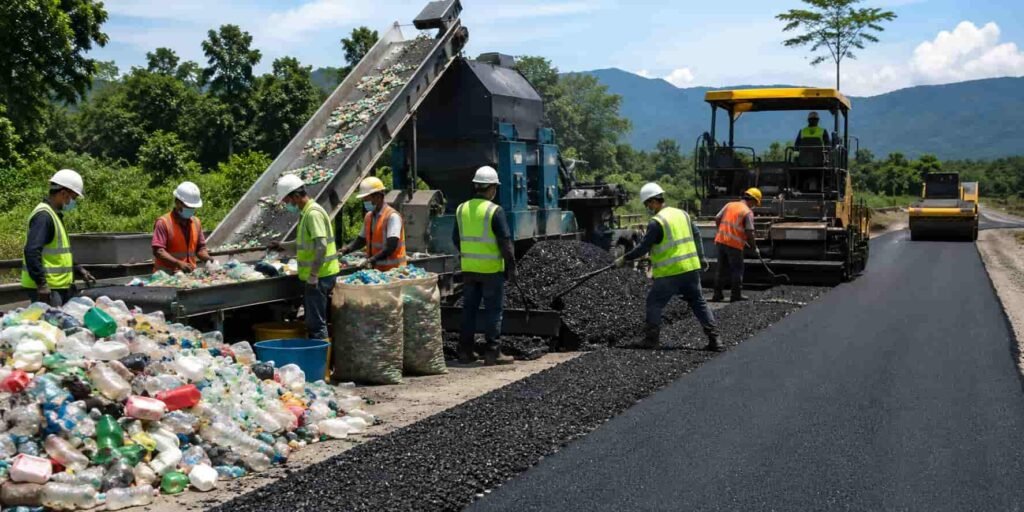
By turning local waste plastics into road material, Hawaii could reduce both the environmental impact and the economic cost of waste management. This approach may also help limit plastic pollution, lower transportation needs, and support more sustainable infrastructure across the islands.
Why Hawaii Is Exploring Plastic-Reinforced Asphalt
Since 2020, many roads in Hawaii have used polymer-modified asphalt to make pavement stronger and longer lasting. This type of asphalt is more flexible than regular road material, so it can better handle cracking, rutting, rain, and water damage. These qualities are especially useful in Hawaii’s tropical climate.
Traditional polymer-modified asphalt is made by melting styrene-butadiene-styrene, also known as SBS polymer, into a sticky petroleum-based asphalt binder. This binder is then mixed with hot aggregates, such as rocks and sand, before being laid down as road pavement.
Researchers began asking whether some of this new, unused virgin polymer could be replaced with discarded plastic waste. They also wanted to test whether recycled plastic roads would remain strong and safe over time. Another key concern was whether these roads could release microplastics, chemicals, or other harmful materials into the environment.
To study these questions, the Hawaii Department of Transportation worked with environmental chemist Jennifer Lynch, director of the Center for Marine Debris Research. Her team is examining whether recycled plastics can be used responsibly in road construction while reducing waste and supporting more sustainable infrastructure.
Read Also: DNA Origami Vaccines May Beat mRNA [Next Leap]Turning Abandoned Fishing Nets Into Road Material
The Hawaii Department of Transportation asked Lynch’s team to focus on two important goals. The first was to provide abandoned fishing nets collected from Hawaii’s waters so they could be tested in recycled plastic asphalt.
These old fishing nets are a major form of marine debris and can harm ocean life if they remain in the water. By reusing them in road construction, researchers hope to turn harmful plastic waste into a useful material for stronger and more sustainable roads.
Testing Plastic-Based Asphalt for Safety and Durability
According to Lynch, foreign derelict fishing gear is one of the biggest sources of marine debris affecting Hawaii’s oceans. Through the CMDR Bounty Project, licensed commercial fishers receive a financial reward for removing large pieces of abandoned fishing gear from the Pacific Ocean. So far, the project has collected about 84 tons of this harmful waste.
The second part of the research focused on environmental safety. Scientists wanted to find out whether recycled plastic asphalt releases more microplastics than regular SBS-modified asphalt.
The Center for Marine Debris Research has advanced laboratory tools that can measure and study microplastics in environmental samples. This makes the project especially important because the same team is both removing plastic pollution from the ocean and studying how it can be reused in long-lasting local infrastructure.
After a U.S. company processed the recovered plastic waste into materials suitable for asphalt production, the Hawaii Department of Transportation tested the idea on a real road. A local paving company resurfaced parts of a residential street on Oahu using three types of asphalt: one made with standard SBS polymer, one using recycled polyethylene from Honolulu’s residential recycling program, and one using polyethylene recovered from discarded fishing nets.
Nearly 11 months later, Lynch’s team returned to the site to collect road dust samples from each section. These samples were tested to see whether the different asphalt mixtures released microplastic particles into the nearby environment.
Read Also: Physicists Reveal Fractional Fermi Sea [Quantum]Checking Road Dust for Plastic Particles
The scientists studied road dust samples to find out what types of materials were coming from the pavement. They separated different polymers, including microplastics, larger plastic fragments, and tire rubber.
To identify the source of these materials, the team used pyrolysis gas chromatography-mass spectrometry, also called Py-GC-MS. This advanced testing method helps scientists understand what chemicals are present and where they likely came from.
The results showed styrene and butadiene from standard polymer-modified asphalt. They also found polyethylene from roads made with recycled plastic and discarded fishing nets. In addition, isoprene and butadiene rubber were linked to normal vehicle tire wear.
These findings helped researchers compare standard asphalt, recycled plastic asphalt, and fishing net-based pavement to see how much microplastic shedding each material may release into the environment.
Early Results Show Low Plastic Release From Recycled Asphalt
Early results suggest that pavement made with recycled polyethylene does not release more polymers than regular SBS-modified asphalt. Similar results were also seen during laboratory performance tests and in simulated stormwater samples collected from the test road sections.
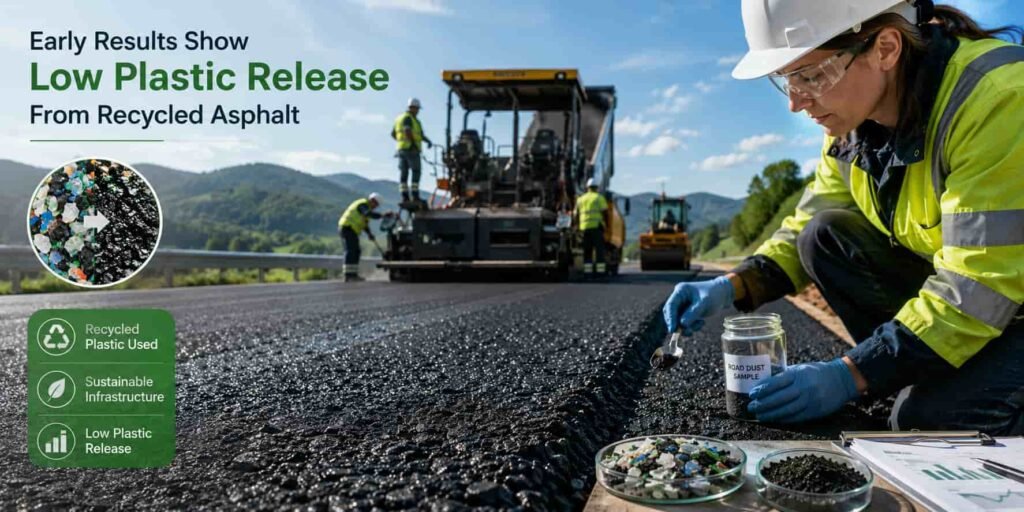
Researchers did find some microplastic-sized particles, but only a very small amount was identified as polyethylene. This was true across all pavement types. The likely reason is that the plastic becomes mixed into the asphalt binder during road production. As the road slowly wears down, the released particles are not pure plastic. Instead, they are a mixture of rock, asphalt binder, and polymer.
The team is also comparing the amount of polymer release from the pavement with the amount of tire wear particles found in road dust. Early Py-GC-MS analysis showed that material from vehicle tires was much easier to detect than polyethylene. In fact, the signal from tire rubber was far stronger, meaning researchers had to look very carefully through the chromatogram to find small traces of recycled plastic.
These findings suggest that recycled plastic asphalt may not be a major source of microplastic pollution, but researchers still need longer-term testing to understand how the material behaves as roads age.
Recycled Plastic Roads Could Help Reduce Waste in Hawaii
Researchers still need more testing to understand how recycled plastic roads perform over many years. They must study whether the pavement remains strong, safe, and durable under daily traffic and Hawaii’s tropical weather.
However, early findings suggest that this approach could become a useful way to manage plastic waste. If the method works on a larger scale, it may help reduce landfill waste, limit marine debris, and give discarded plastics a second life in road construction.
Lynch explained that some people believe plastic recycling does not work because it is difficult and expensive. But this research shows that recycling can be effective when communities make sustainability a real priority.
The project was supported by the Hawaii Department of Transportation, which funded the research into recycled plastic asphalt and its possible role in building cleaner, more sustainable infrastructure.
Studying Recycled Plastic Asphalt for Cleaner Roads and Oceans
Polymer-modified asphalt, also called PMA, is used to make roads stronger, more flexible, and more durable. In Hawaii, this asphalt is usually made with a new polymer called styrene-butadiene-styrene, or SBS. Researchers are now studying whether recycled plastics, especially high-density polyethylene or HDPE, can replace some of these new materials and help reduce plastic waste.
One major source of plastic pollution in Hawaii is derelict fishing gear, also known as DFG. This abandoned fishing equipment is a serious marine debris problem, but it can also provide useful recycled HDPE for road materials. However, scientists still need to understand how well these recycled materials perform in asphalt and whether they release microplastics or plastic additives into the environment.
In partnership with the Hawaii Department of Transportation, the University of Hawaii, and the Center for Marine Debris Research, researchers are testing different types of recycled plastic asphalt. The study compares several asphalt mixtures, including SBS control asphalt, DFG-based asphalt, local waste HDPE asphalt, and commercial post-industrial recycled HDPE asphalt. Some mixtures include SBS polymer, while others are made without it.
The team tested these materials in the laboratory using the Hamburg Wheel Tracker Test, also known as HWTT, to study road performance and collect water samples. They also carried out field testing on a residential road in Oahu, Hawaii. Researchers collected road dust samples and tested them for microplastic particles, bound plastic, and chemical additives.
To identify the materials, the scientists used advanced methods such as pyrolysis gas chromatography-mass spectrometry, solvent extraction, water extraction, solid phase extraction, and gas chromatography-mass spectrometry. These techniques helped them measure where the plastic particles and additives came from.
The results may help decide whether recycled HDPE can be safely used instead of virgin plastics in road construction. If successful, this approach could give plastic marine debris a useful second life, reduce waste in landfills, support sustainable infrastructure, and help protect cleaner and healthier oceans.
Summary: Hawaii Builds Roads From Fishing Nets [Ocean Rescue]
Hawaii is testing recycled plastic asphalt as a way to reduce plastic waste, marine debris, and pressure on crowded landfills. Researchers are using materials such as discarded fishing nets, household plastic waste, and recycled HDPE in road construction. Early results show that these roads do not appear to release more microplastics than standard SBS-modified asphalt. Scientists found that tire wear particles were much more common