![Creatine May Help Fight Cancer [New Research]](https://giglegravity.site/wp-content/uploads/2026/07/Creatine-May-Help-Fight-Cancer-New-Research.jpg)
Creatine May Help the Immune System Fight Cancer
Creatine is commonly known as a sports supplement used by athletes and bodybuilders to support muscle strength, energy, and physical performance. However, new UCLA research suggests that creatine may also play an important role in cancer immunity.
The study, published in iScience, found that creatine may help the immune system respond more strongly against cancer cells. Researchers discovered that creatine boosts the activity of dendritic cells, which are important immune cells that help the body detect tumors.
These dendritic cells then activate killer T cells, also known as cancer-fighting T cells, which can attack and destroy harmful cancer cells. The research was based on tests using mice and human cells.
The findings also support earlier work from the same UCLA laboratory, which showed that creatine may improve the function of T cells involved in the body’s anti-cancer immune response.
In simple terms, creatine may do more than help build muscle. It may also help the body’s natural defense system become stronger against tumor growth and cancer progression.
Creatine Could Support Cancer Immunotherapy
Many modern cancer immunotherapies are designed to activate killer T cells, which help the body find and destroy cancer cells. However, only about 20% to 40% of patients receive strong benefits from these treatments.

According to the UCLA research team, one way to improve immunotherapy may be to strengthen dendritic cells. These immune cells help guide T cells and prepare them to attack tumors. By improving dendritic cell function, researchers believe immunotherapy may become useful for more patients.
Lili Yang, the study’s senior author and a UCLA professor of microbiology, immunology, and molecular genetics, explained that immunotherapy is promising, but it does not work well for everyone. The study suggests that creatine may not only support cancer-fighting T cells, but also help the wider immune system structure that directs and supports those cells.
How Creatine Affects Dendritic Cells
To understand the role of creatine in the immune response, scientists studied metabolic genes in dendritic cells that had entered tumors in mice. They found that the gene responsible for making the creatine transporter was much more active in tumor-infiltrating dendritic cells than in dendritic cells from healthy tissue.
The creatine transporter is a protein that helps move creatine into cells. When researchers created dendritic cells without this transporter, the cells became weaker. They did not survive as well, were less active, and were much less able to help T cells recognize and attack tumor cells.
In laboratory tests, these creatine-deficient dendritic cells were placed together with T cells. The T cells multiplied less and produced fewer signaling molecules, which are needed to build a strong anti-cancer immune response.
Creatine Reduced Tumor Growth in Mice
Researchers also tested whether increasing creatine levels could have the opposite effect. In mouse models of melanoma, daily creatine injections significantly slowed tumor growth.
The treatment also increased the number and activity of dendritic cells inside the tumor. These strengthened immune cells released more chemical signals, which helped attract other immune cells into the tumor environment.
In simple terms, the study suggests that creatine may help the immune system work better by supporting dendritic cells, improving T cell activation, and strengthening the body’s natural ability to fight cancer. This could make creatine a promising support option for future cancer immunotherapy research.
Creatine May Help Power Immune Cells Against Cancer
Using metabolomics analysis, researchers found that creatine supplementation increased intracellular ATP levels inside dendritic cells. ATP is the main energy source cells use to perform important biological tasks.
By increasing these energy reserves, creatine helped support the inflammatory signaling pathways needed for dendritic cell activation. These pathways allow dendritic cells to stay active and help the immune system respond more effectively to cancer cells.
Researchers compared creatine’s role to a rechargeable battery. In simple terms, creatine may help dendritic cells store and use energy when they need it, even inside the difficult tumor environment, where fast-growing tumor cells compete for limited nutrients.
Read Also: 4,000-Year-Old Tablets Reveal Lost Magic [Shocking]Creatine May Improve Dendritic Cell Cancer Vaccines
The research team also studied how creatine affects human immune cells in laboratory tests.
They found that creatine improved the activation of human monocyte-derived dendritic cells. These cells are often used in the development of dendritic cell cancer vaccines, which are designed to train the immune system to recognize and attack cancer.
Creatine also strengthened the ability of these dendritic cells to activate human T cells against a cancer-associated target. This suggests that adding creatine during the production of dendritic cell-based vaccines may help improve the quality and possible effectiveness of these treatments.
According to the researchers, creatine may have two possible uses in future cancer care. First, it may work as a supplement to support the immune response in patients receiving immunotherapy. Second, it may help improve dendritic cell vaccines before they are given to patients.
Creatine May Support Anti-Cancer Immunity at Different Stages
Overall, the findings suggest that creatine could help strengthen the body’s anti-cancer defenses in more than one way. Instead of only supporting killer T cells, creatine may also support the earlier immune cells that detect cancer and start the body’s response.
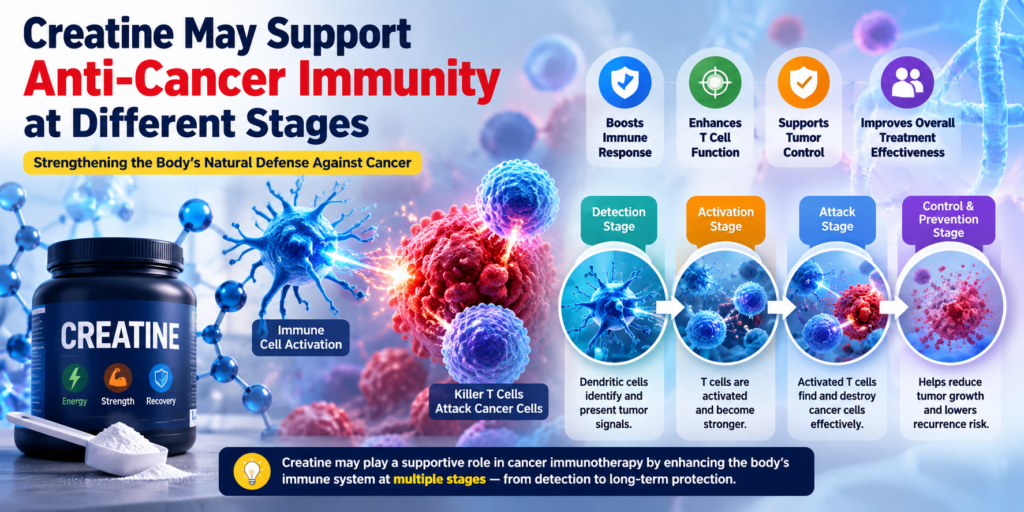
This is important because dendritic cells play a central role in guiding the anti-tumor immune response. When these cells have enough energy, they may be better able to activate T cells, send immune signals, and help the body recognize tumor cells more clearly.
More Human Research Is Needed
Although the results are promising, the researchers warned that the study is still at an early stage. The experiments were done in mice and in human cells grown in the laboratory, not in cancer patients.
For this reason, the findings should not be taken as proof that creatine supplements can improve cancer treatment in people. More human clinical trials are needed to confirm whether creatine can safely and effectively support cancer immunotherapy, dendritic cell vaccines, or other anti-cancer immune therapies.
In simple words, creatine may help immune cells produce and use more energy, which could make them stronger against cancer. However, it is not yet proven as a cancer treatment for humans.
Creatine Safety and Medical Guidance
Although creatine monohydrate has been used for many years and is generally considered safe when taken at recommended doses, researchers emphasized an important caution. Anyone receiving cancer treatment should speak with their doctor before adding creatine or any other supplement to their daily routine.
This is especially important for patients undergoing cancer immunotherapy, because supplements may interact with treatment plans, medications, or individual health conditions.
Read Also: New Weight Loss Pill Beats Oral Ozempic [Major Trial]Clinical Trials Are the Next Step
The researchers stated that the next major step is to conduct prospective clinical trials. These studies will help determine whether creatine supplementation can improve treatment results for patients receiving cancer immunotherapy.
At this stage, the findings are promising but still early. The experimental methods described in the study have not yet been tested in human cancer patients. They have also not been approved by the Food and Drug Administration as safe and effective for use in people.
In simple terms, creatine may have potential as a support tool in future cancer immune therapy, but it is not yet proven or approved as a cancer treatment.
Research Funding and Patent Information
The study was supported by several research grants and programs, including the UCLA Broad Stem Cell Research Center Rose Hills Foundation Innovator Grant, the UCLA Health Jonsson Comprehensive Cancer Center, the UCLA Broad Stem Cell Research Center Ablon Scholars Program, the Magnolia Council Senior Investigator Grant Award, and a fellowship from the Tower Cancer Research Foundation.
The possible therapeutic strategy identified in the study is also linked to a patent application filed by the UCLA Technology Development Group on behalf of the Regents of the University of California.
Overall, the research suggests that creatine monohydrate may have future potential in supporting anti-cancer immune responses, but more human clinical trials are needed before it can be recommended for patients receiving cancer immunotherapy.
Summary: Creatine May Help Fight Cancer [New Research]
Creatine, commonly known as a sports supplement, may also help support the immune system in fighting cancer cells. UCLA researchers found that creatine can boost dendritic cells, which activate killer T cells and strengthen the body’s anti-cancer immune response. In mice and lab-grown human cells, creatine improved immune cell energy, slowed tumor growth, and showed potential for supporting cancer immunotherapy and dendritic cell vaccines. However, these findings are still early, and more human clinical trials are needed before creatine can be recommended for cancer patients.