![Europe’s Most Active Volcano Has a Secret Origin [Revealed]](https://giglegravity.site/wp-content/uploads/2026/07/Europes-Most-Active-Volcano-Has-a-Secret-Origin-Revealed-1.jpg)
Scientists Uncover a Possible New Origin of Mount Etna
Mount Etna may be the only massive volcano on Earth created by a previously unknown volcanic process that scientists are only beginning to understand. Located on the Italian island of Sicily, it is recognised as the most active volcano in Europe, producing several eruptions each year. Despite decades of research, its exact formation has remained a major geological mystery.
A new study by researchers at the University of Lausanne, also known as UNIL, offers a possible explanation. The scientists suggest that Mount Etna may have developed through a rare movement of magma, tectonic plates, and material beneath the Earth’s crust.
This process appears to be different from the mechanisms responsible for forming other large volcanoes around the world. The discovery could make Mount Etna a unique example of volcanic formation and may help researchers better understand volcanic activity, magma movement, and the hidden geological forces operating deep inside the Earth.
Mount Etna Challenges Traditional Volcanic Theories
More than 500,000 years old and standing over 3,000 metres or 9,800 feet above sea level, Mount Etna has never fully matched existing theories of volcano formation.
The latest research, published in the Journal of Geophysical Research: Solid Earth, was carried out with Anna Rosa Corsaro from the Istituto Nazionale di Geofisica e Vulcanologia, or INGV, in Catania, Italy. The findings could also support more accurate volcanic hazard assessments, helping scientists better understand possible risks linked to future eruptions.
How Most Volcanoes Develop
Volcanoes form when molten rock, known as magma, rises from the Earth’s mantle, reaches the surface and cools into solid rock. Scientists usually divide volcanoes into three main groups according to how their magma is produced.
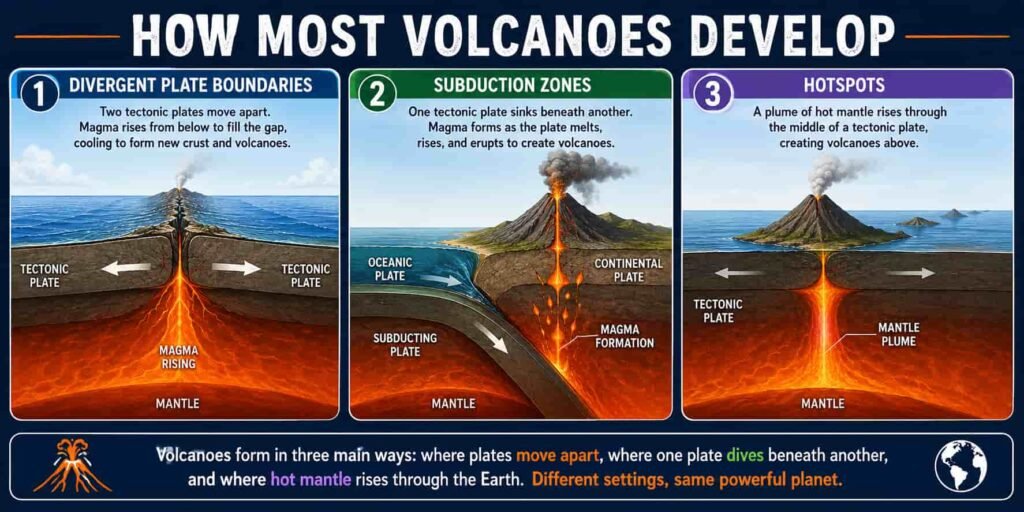
Diverging Tectonic Plates
Some volcanoes form where two tectonic plates move away from each other. This movement allows hot material from the mantle to rise, melt and create new oceanic crust.
Subduction Zones
Other volcanoes develop where one tectonic plate moves beneath another. Water carried deep into the Earth lowers the melting temperature of nearby rock, creating magma. This process can produce powerful and explosive volcanoes, including Mount Fuji in Japan.
Mantle Hotspots
Volcanoes can also form far from plate boundaries. In these areas, unusually hot mantle material rises through the crust at a hotspot. This process creates volcanic island chains such as Hawaii and La Réunion.
Why Mount Etna Is Different
Mount Etna does not clearly belong to any of these recognised categories. Although it is located close to a subduction zone, the chemical composition of its lava is more similar to lava produced by hotspot volcanoes.
However, scientists have found no clear hotspot beneath Sicily. This unusual combination makes Mount Etna a major geological puzzle and suggests that a rare or hidden volcanic mechanism may be responsible for its formation.
Deep Magma Reservoirs May Power Mount Etna
Scientists believe Mount Etna may receive its magma from small, long-lasting pockets hidden deep beneath Sicily. These magma reservoirs may lie in the upper mantle, around 80 kilometres, or 50 miles, below the Earth’s surface.
Unlike the magma beneath many volcanoes, which forms shortly before an eruption, Etna’s magma may remain stored underground for very long periods. It is then slowly forced upwards by the movement of the African Plate and the Eurasian Plate.
As these two tectonic plates collide, the plate near the subduction zone bends and develops cracks. These fractures create pathways through the Earth’s crust, allowing magma to rise towards the surface. Researchers compare the process to liquid being pressed out of a sponge.
This hidden movement of magma could explain Mount Etna’s unusual lava chemistry, its continuous supply of molten rock and its long record of frequent volcanic eruptions.
Etna Could Represent a Rare Fourth Volcano Type
The study suggests that Mount Etna may be a giant example of a little-known group called petit-spot volcanoes. Japanese scientists first identified this type of volcanic activity in 2006.
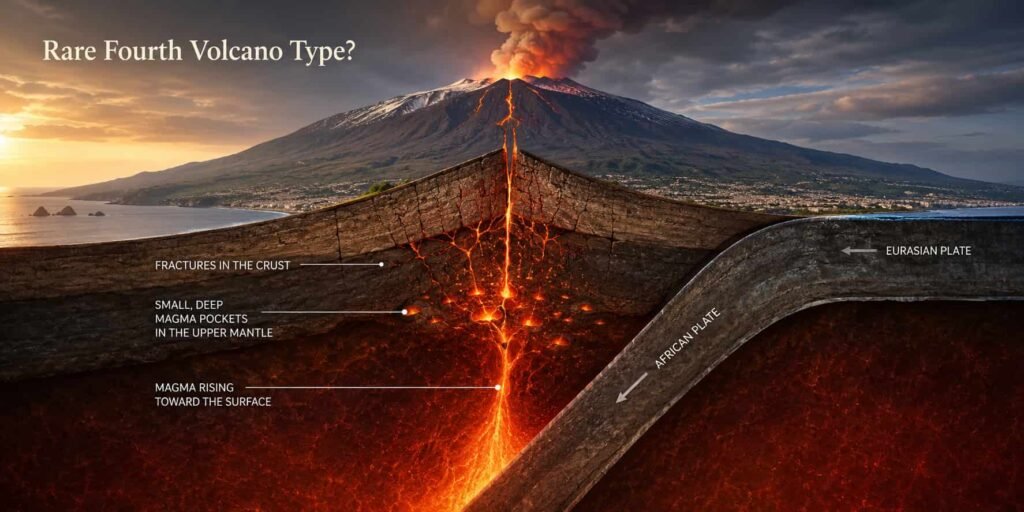
Petit-spot volcanoes are usually small underwater volcanoes that form when existing magma pockets near the top of the Earth’s mantle are pushed through cracks in a bending tectonic plate. The idea that such magma could remain stored in the mantle was first proposed during the 1960s.
Until now, scientists had connected this process only with very small volcanic formations, often rising just a few hundred metres from the ocean floor.
According to Sébastien Pilet, a professor at the University of Lausanne and the study’s lead author, Mount Etna may have developed through a similar mechanism. However, Etna is far larger than any previously known petit-spot volcano.
It is a massive stratovolcano that began forming around 500,000 years ago and now stands more than 3,000 metres above sea level. This makes Etna an unexpected and possibly unique example of how the petit-spot mechanism can create a major volcano.
Rock Evidence Supports a New Theory of Etna’s Origin
If this theory is confirmed, it could broaden scientific understanding of volcano formation and encourage geologists to search for similar hidden processes in other parts of the world.
To test the idea, researchers studied rock samples covering nearly 500,000 years of volcanic activity at Mount Etna. They examined changes in the chemical composition of the lava and compared the results with laboratory experiments and existing geological data.
The analysis showed that Etna’s magma chemistry has remained surprisingly consistent, even though the surrounding tectonic environment has changed over time. This stability suggests that the magma supplying the volcano may already be stored in the upper mantle, rather than being newly produced before each eruption.
Scientists believe the movement and bending of tectonic plates controls how much magma rises towards the surface. These findings provide stronger evidence that Mount Etna may be powered by the same deep geological process linked to petit-spot volcanoes.
The results could establish Mount Etna as a rare example of a large volcano formed through a previously overlooked mantle magma process.
Read Also: North Sea Asteroid Hit That Sparked a Mega Tsunami [Shock]Summary
Mount Etna may have formed through a rare petit-spot volcanic process, unlike most large volcanoes. Scientists believe long-lasting magma pockets in the upper mantle are pushed upwards as the African and Eurasian tectonic plates move and bend. This theory explains Etna’s unusual lava chemistry, frequent eruptions and unique geological structure. Rock samples covering about 500,000 years show that its magma composition has remained remarkably stable. The findings could expand scientific knowledge of volcano formation and improve future volcanic hazard assessments.